


Digitalizing Sales Channels and Implementing Digital Branch Solutions in Banking
 Andrew BurakCEO and Founder at Relevant Software
Banks have been shifting from push-style marketing to customer-centric, data-led banking for years, and the pandemic accelerated the shift by making digital services the default for routine needs. In practice, branches now work best when software handles transactions and self-service, while staff focus on advice and complex cases.
Recent numbers show why this model sticks. Bank of America says more than 90% of client interactions happen through digital platforms, yet it still invests in branches for higher-value conversations. McKinsey also describes how digitization translates into measurable results: in one large bank transformation, the share of digital customers doubled to 60%, branch and contact center costs fell by 25%, and the consumer bank’s efficiency ratio improved from 49% to 40%.
Relevant delivers outsourcing and fintech software development services that help banks move from isolated upgrades to a coherent digital branch model. Our team can build custom branch solutions that fit your processes, security requirements, and customer journeys, while keeping integration and governance under control. This article explains why digital branch banking matters and how modern, software-led branch experiences can improve sales performance and service outcomes.
Digital sales: the new normal in banking
Traditional branches started losing routine traffic years before the pandemic, because customers already preferred mobile and online for everyday tasks. By late 2025, a Morning Consult survey for the American Bankers Association found that 54% of U.S. customers manage accounts primarily via a mobile app, while only 9% rely on branches as their main channel. That split shows how strongly digital already shaped customer behavior before any crisis forced the issue.
COVID then accelerated the parts of banking that still depended on in-person steps, especially onboarding and service access. In a 2024 cross-market survey published by Entrust (Onfido), 82% of respondents said they access online banking consistently or mostly online, and digital acquisition already looked mature: 42% registered for an account via an app and 35% via a website. Customers now expect fast sign-up, clear self-service, and consistent journeys across devices.
Today, digital sales and “smart” banking sit in the baseline category, not the innovation bucket. Banks that win treat branches as advisory hubs and let software carry the volume. Bank of America captures the logic: Reuters reports that over 90% of client interactions occur online, yet the bank still expands physical locations to support higher-value conversations. For banks that have not yet built a true digital-branch model, the priority is simple: align mobile, web, and branch workflows so customers can start, continue, and complete financial decisions without channel friction.
The digital stack’s role in bank sales
Transformation towards digital-first bank branches can help financial institutions to increase sales in various ways. Let’s take a look at two hypothetical customer journeys so you get a better picture of how it works.
George and Deborah’s banking matters
Let’s imagine George wants to print a financial statement at the self-service terminal system (SSTS). Upon accessing the terminal, the analytical model detects George as a small business owner with steady revenue.
After printing the financial statement, the terminal displays an offer to open a business account. George accepts and uses the SSTS to schedule a meeting with a banking associate. The next day, George opens a new account from home via video conference. There, he uploads his scanned documents and signs a contract with an electronic signature.
In another case, Deborah uses the bank’s mobile app to pay off loans she received from a different bank. The analytical model checks her credit score, monthly income, and preferred communications method. The system also takes note of Deborah’s favorite coffee shops and online stores.
Next, the app sends a pop-up notification offering Deborah a new credit card on favorable terms with a low-interest rate. And the icing on the cake, the bank even offers cashback rewards when she pays in her favorite shops. Deborah accepts the offer and uses the mobile app to customize the card’s design and orders it to be delivered. Meanwhile, the card automatically appears on her account.
As you can see, the bank managed to predict customers’ needs to provide services they could really use. In George’s case, the system even managed to convert a low-value transaction into a high-value deal. Now, what role does the digital stack play in both examples?
How digital-first bank branches help banks upsell their services
The digitalization has affected George and Deborah’s customer journeys on several tiers. Let’s analyze each of them:
- Data. This tier collects information about customer behavior on internal and third-party digital channels. For instance, the bank sees George’s and Deborah’s incomes, credit scores, and products they’re interested in.
- Analytics. AI and machine learning technologies look for offers that George and Deborah might find helpful.
- Marketing. The analytical model detects Deborah’s favorite communication method (messaging apps, SMS, emails) to personalize her offer. George receives a proposal right after he finishes his business (printing a statement).
- Engagement. The software factors in the optimal time to interact with the user. If Deborah didn’t click on the pop-up notification right away, the system would have sent an offer via email and WhatsApp messages over the next few weeks. As for George, the SSTS allowed him to set a meeting at a convenient time.
- Fulfillment. George opens a business account through a conference call, and Deborah orders a card via the mobile app.
The stories we described above perfectly capture how digitalization can enhance sales. That doesn’t mean banks should implement these exact solutions, but they’ll have to rethink their business models to meet customer’s needs more efficiently.
Four ways to make digital sales work for your institution
According to Mobiquity’s 2021 Digital Banking Report, over 40% of customers would switch banks to get better digital tools. And the thing about smart banks—they are quick and easy to sign up for. Switching won’t be hard because users can upload scans of their ID, apply an electronic signature, and order a card within minutes.
To optimize your digitized banking service, you should place the customer at the center of your digital transformation and financial app development.
Here are some recommendations you may want to follow during this process.
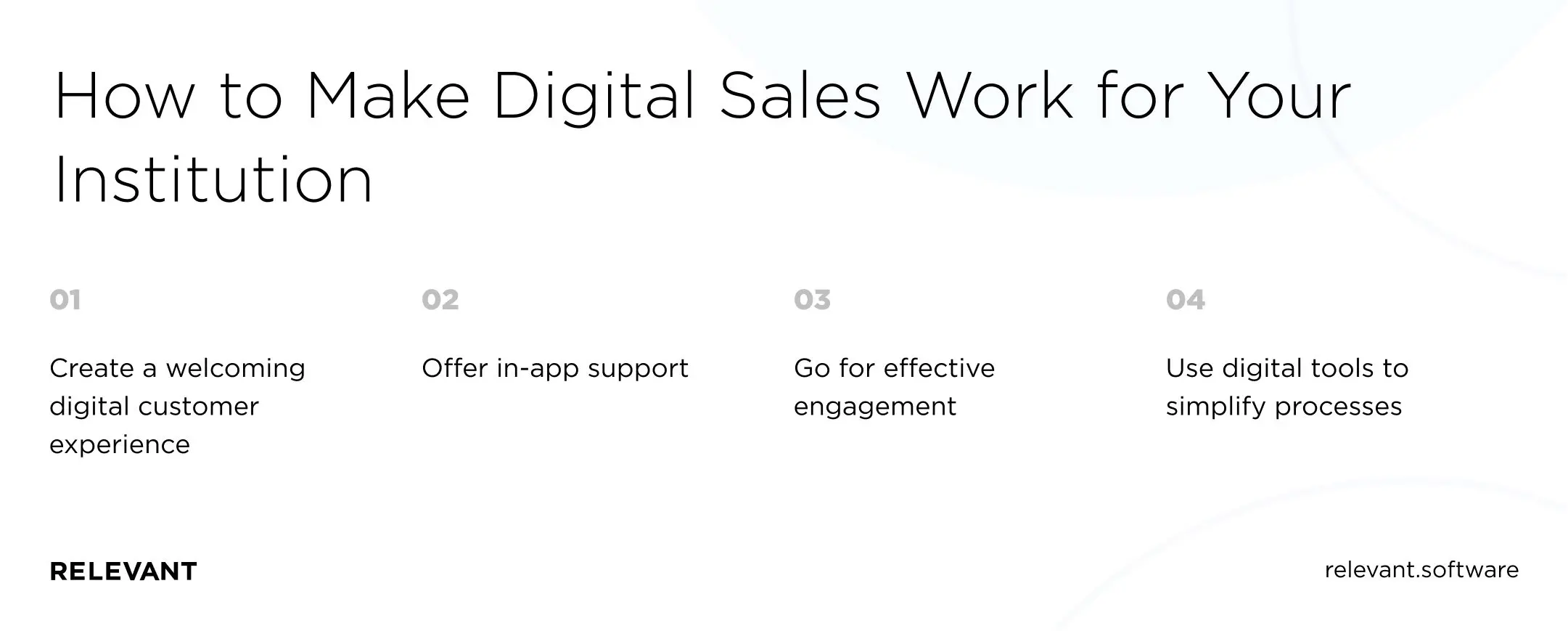
1. Create a welcoming digital customer experience
Retail banks’ customers should always feel welcomed. How do you achieve this? Some best practices include:
- Fast registration. It is one of the most effective ways to attract new customers to your bank.
- User-friendly design. It will help users navigate through your solutions.
- Biometric authentication. It will ensure fast and convenient access to the online service.
- Digital signatures. It will reduce paperwork and enable easy and seamless transactions.
- Automated reports. They will allow customers to create business statements at a preset time or in intervals.
- Screen sharing technology. It can replicate the advantages of in-person interactions.
- Gratification techniques (such as celebratory music after a successful transaction). They can make the process more pleasurable.
- Digital self-service. It allows users to quickly resolve issues on their own.
You can also enhance your offering by partnering with merchants and marketplaces. For example, users can receive discounts or cashback when paying for goods or services via your app or card.
Another key goal is to make your customers feel that your company is always ready to assist them. You can make this possible with digitals tools and customer support.
2. Offer in-app support
Direct support is crucial as bank accounts become increasingly digital and customers perform many transactions themselves. In general, in-app customer support can be delivered in multiple formats:
- AI-powered chatbots can help customers with basic operations and navigation
- Interactive voice response (IVR) with contextual awareness can provide tailored responses to customers’ questions
- Curated messaging in the form of in-app insights and push notifications will help users learn more about an app as they use it
Despite these practical tools, businesses still need to have a customer support team. Ideally, users should be able to reach real operators via an app whenever they need to.
3. Go for effective engagement
Digital sales are about offering the right product to the right customers—when they need it and how they want it. To engage with customers more effectively, you can use the following solutions:
- Customer-relationship-management (CRM) tools. They use product descriptions, client behavior, and socio-demographic data to personalize offers.
- A multichannel contact tree. It allows bank representatives to communicate with the customer via their preferred digital channels.
- Advanced analytics software. It improves data collection and processing to tailor services to the needs of individual users.
A side note here, the integration of all systems is essential. But you need to remember that they will work with large volumes of personal information. So your IT ecosystem must include a reliable fintech app security solution to prevent data leaks.
Relevant can upgrade your software with the latest features, such as role-based access control, secure app logic, adaptive authentication, military-grade data encryption, and tokenization. Our dedicated software development teams can also implement cybersecurity into the core of the development process.
4. Use digital tools to simplify processes
Customers want advanced services to be at their fingertips. You can implement most simple transactions with apps or other solutions. Some of the functionality people expect from digital banking tools are:
- Fund management
- Money transfers
- Loans
- Insurance
- Taxpaying
- Paying fines
- Reviewing statements
- Querying transactions
Many high-value financial transactions can’t be entirely online. Customers still need to visit bank branches to get a mortgage, withdraw large sums of money, or close a huge deal.
But your aim should be to make even complex transactions like that feel effortless. At the same time, less tech-savvy customers must be able to find support if they face a challenge. Both of these goals could be achieved by creating digital bank branches.
Smart digital branches
Digital branches should offer a unified customer experience and, ideally, 24/7 access for complex interactions. Here are the key solutions that can make this possible.
- ITM (interactive teller machine). ITMs allow customers to access core functions and connect to bankers outside of physical branches. These machines come with scanners, authenticators, facial recognition software, and ID readers. Even less digitally literate people can use ITMs to receive bank cards and loans.
- Self-service terminal system (SSTS). These devices have fewer features than ITMs. Customers can use them inside and outside of bank branches to conduct simple transactions. SSTSs can also offer personalized offers during low-priority operations.
- Specialized banker tablet. Advanced tablets allow bank operators to access real-time data about customers and make offers on the spot.
- Robot greeter. According to CPG’s Two Customer Personas of COVID-19 White Paper, many customers expect pandemic-related restrictions to have a long-term impact. Robot greeters might be the best solution, offering tailored advice and touchless services.
- Interactive welcome screen. Welcome screens and walls offer an experience similar to ITMs, but with a better interface and more screen real estate for advertising.
- Video-conferencing machine. These devices are made for complex operations, such as mortgages and business-to-business deals. Many banks provide dedicated video conference rooms to help users get advice and update crucial business details in a secure environment.
These digital solutions can be possible with a centralized data system and advanced banking software. If you want to improve your platform or build it from scratch, you might consider hiring remote dedicated developers with relevant expertise.
Relevant is an IT outsourcing company that has experienced developers with qualifications in various programming languages, deep industry knowledge, and some of the most favorable rates.
Summary
Bank customers will continue to move toward digital tools. Although physical branches won’t lose their relevance altogether, it’s vital to reinvent bank branches for the digital age to attract more clients.
Financial organizations striving to keep up with the times should focus on digital sales. This means providing an omnichannel experience that links online, mobile, and physical branches into a seamless ecosystem with a personalized approach for every customer.
Do you want to enhance your sales with innovative solutions? Drop us a line to learn how we can guide your financial institution towards digital transformation.


