
Top Web Development Companies for Scalable Digital Products
 Vadim StrukProduct Manager and Head of Business Analysis at Relevant Software
There are tens of thousands of web development companies on the market, along with many web design agencies competing with them. This scale creates the real problem: more choice does not mean more clarity. When thousands of vendors claim similar tech stacks and similar results, the decision comes down to evidence you can actually verify.
This guide helps CTOs, product leaders, and procurement teams shortlist top web development companies using criteria that predict delivery in production: architecture ownership, quality gates, security posture, and operational readiness. You will also find a comparison table and a curated list that emphasizes complexity handling and delivery maturity on web development services.
Comparison table: best web development companies
Before you dive into the company profiles, this table gives a fast way to compare providers side by side. It pulls together the details that usually matter first in a shortlist: core web development services, delivery locations, Clutch review signals, notable client references, and typical pricing bands.
| Company | Core services | Locations | Clutch reviews | Notable clients or public case examples | Pricing range |
| Relevant Software | Custom web app development, UX/UI, DevOps, AI | Lviv (Ukraine), Warsaw (Poland), Valencia (Spain) | 4.9 | AstraZeneca, Volkswagen,Ossur | $50 – $99 / hr |
| WOLFPACK DIGITAL | Product discovery, UX/UI, custom web and mobile, AI | Cluj-Napoca, Romania | 5.0 | Rainist, Libon, Transylvania College | $50–$99/hr; $25k+ |
| Adchitects | Web design and development, eCommerce, UX/UI | Poznań, Poland | 4.9 | Atlantic Sapphire, Apollo Scooters | $10,000+ • $50–$99/hr |
| GLOBALDEV | Custom software, web platforms, product teams | Warsaw, Poland | 4.9 | Allseated, Axonlab, Pliant | $25–$49/hr; $50k+ |
| Solid Digital | UX/UI, web design, B2B web platforms | Chicago (US) | 4.9 | Restaurant365, IMO Health | $150–$199 |
| SapientPro | Custom web development with platform builds and eCommerce-focused work | Luzern, Switzerland | 4.9 | SalesLog | $25–$49/hr; $5k+ |
| Pronto Marketing | Managed WordPress development, SEO support, and website maintenance | Bangkok, Thailand | 5.0 | LaPorte Law Firm | $25–$49 |
| Lumitech | SaaS-style web development with AI/ML integration options | Dubai, UAE | 5.0 | Arq Decisions, Reputable Health | $25,000+ • $50–$99/hr |
| Solar Digital | Web development and UX with a digital-product studio format | London, UK | 5.0 | AllTech National Title | $10,000+ • $50–$99/hr |
| Code District | Web development and systems integration | Washington, DC | 5.0 | AstraZeneca, STC Pay, Caribbean Airlines | $25–$49/hr; $10k+ |
Note: Use this table for quick screening, not final selection. Directory listings may be outdated, rates change with team seniority and scope, and “notable clients” only reflect what a company can publicly name or publish as a case study.
What defines a top web development company today
In 2026, most web products stay in motion because business needs shift, integrations expand, and security expectations rise. A top development agency supports user experience and a strong online presence by setting up a web system that remains predictable over time, with UI design that supports user engagement and business growth, and custom solutions that match a real digital presence, not a one-time launch.
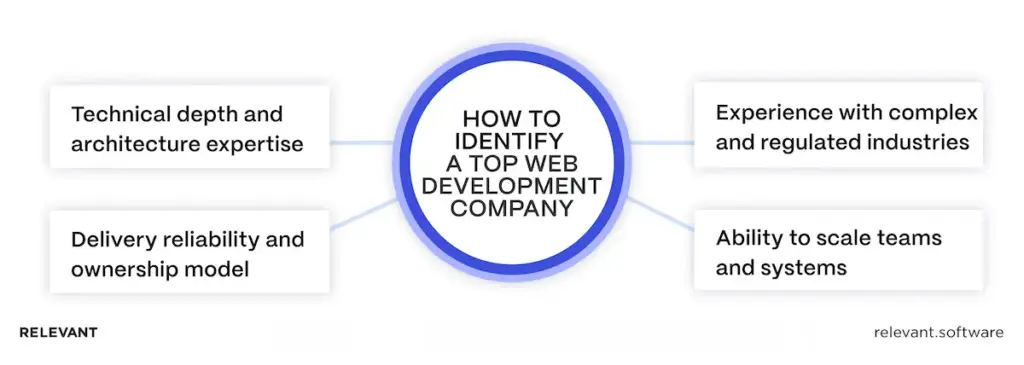
Technical depth and architecture expertise
Good architecture rarely looks impressive in week one. It proves itself later, when a “small” change does not trigger a cascade of bugs or a performance drop. Strong teams explain tradeoffs clearly, choose patterns that fit your constraints, and define how they will measure success after launch across responsive websites and progressive web apps, including cases where mobile app development connects to the same platform.
Look for signals in how they approach architecture choices, performance, data design, and security foundations, while also checking how they use the latest technologies, such as artificial intelligence, without weakening quality assurance. A mature team can connect those decisions to online visibility, digital marketing strategies, and website design goals, not only software development.
Experience with complex and regulated industries
In regulated, high-risk industries, mistakes are expensive. You can’t rely on “we’ll fix it later” when audits, security reviews, and customer trust are on the line. The best web development company integrates compliance, security, and traceability directly into the development process and documents decisions so they stand up during audits and long-term digital transformation.
A credible team shows how it applies secure engineering standards, manages risk, and produces audit-ready evidence without slowing delivery. At the same time, it delivers a strong user experience, sound product decisions, and consulting that ties directly to business outcomes.
Delivery reliability and ownership model
Reliable delivery comes down to ownership. You need to know who makes tough decisions, who enforces quality standards, and who takes responsibility when production behaves differently from staging. This shows up in how a partner runs reviews, handles feedback, and communicates day to day, regardless of whether they position themselves as a digital agency, marketing agency, or software solutions provider.
In practice, strong delivery looks like discovery that leads to real decisions, disciplined releases, and operational readiness.
Ability to scale teams and systems
Scale is not only a traffic problem. It is also a change problem. The system must handle growth, and the delivery setup must handle more features, more integrations, and more people without a quality slide. It is especially crucial for small businesses and enterprise teams in the United States, including hubs like New York.
A strong partner can build large-scale web applications and add capacity without disruption, extend the platform safely, and maintain predictable performance. If you plan to expand your internal team rather than outsource a full scope, you may prefer a partner that lets you hire web developers quickly without losing delivery control.
Top 10 web development companies (curated list)
Strong web teams make delivery feel straightforward. They ship stable releases, keep performance predictable, and handle integrations without drama. This list highlights companies that can deliver scalable web solutions with solid security and long-term maintainability.
1. Relevant Software
Relevant Software is one of the top IT outsourcing companies, building secure, integration-heavy web platforms with clean architecture and predictable releases. The team adds AI integration plus DevOps discipline, so deployment, monitoring, and ongoing change stay under control.
- Core services: Custom web app development, PWA development, UI/UX design, AI in web development, DevOps and CI/CD, CTO support, and technical leadership.
- Key industries: Fintech, proptech, retail, and healthcare.
- Engagement models: Dedicated team, time and materials, product discovery.
- What sets them apart: They develop scalable solutions with strong architectural leadership and delivery control, reflected in 98% client satisfaction. A 92% senior talent mix keeps decisions senior-led from architecture through release.
- Best fit for: Startups and enterprises building secure SaaS or regulated platforms with a clear integration complexity objective.
2. WOLFPACK DIGITAL
WOLFPACK DIGITAL runs end-to-end delivery with clear communication and steady execution across releases, supported by strong public satisfaction signals. The team brings experienced top web developers who keep UX decisions aligned with engineering tradeoffs.
- Core services: Full-stack web delivery, front-end engineering (React, Vue, Angular), product discovery support.
- Key industries: Healthtech, fintech, transportation.
- Engagement models: Dedicated teams, fixed-scope MVP builds.
- What sets them apart: Strong process discipline and consistently high client satisfaction signals.
- Best fit for: Teams that want a partner to lead both UX execution and engineering delivery.
3. Adchitects
Adchitects pairs design strength with performance-aware implementation, so websites stay fast, structured, and easy to update. That mix aligns with what teams expect from the best website development companies when both brand and conversion matter.
- Core services: UI/UX design, WordPress or headless CMS, front-end development.
- Key industries: Tech, professional services, and eCommerce.
- Engagement models: Project-based, ongoing support retainers.
- What sets them apart: They combine design craft with engineering structure, so the site looks premium while still staying fast, modular, and easy to evolve with content and marketing changes.
- Best fit for: Firms that need a high-converting web presence with strong UI design and fast, responsive performance.
4. GLOBALDEV
GLOBALDEV provides broad engineering coverage and can scale teams when projects need specialist roles in data, AI, and platform work. It often lands on shortlists of top web application development companies for complex web applications with multiple parallel workstreams.
- Core services: Full-cycle engineering, AI/ML support, DevOps.
- Key industries: Logistics, finance, and education.
- Engagement models: Staff augmentation, dedicated teams, solution design.
- What sets them apart: They can staff complex programs with specialist coverage across engineering, data, and DevOps, while keeping delivery visible through a straightforward process and reporting.
- Best fit for: Teams running larger web platform programs that need scalable delivery capacity and specialist coverage across data, AI, and DevOps.
5. Solid Digital
Solid Digital connects web delivery to measurable business goals, which helps teams align UX, content, and engineering. The approach fits organizations comparing top website development companies for growth-focused web programs.
- Core services: Web development, UI/UX, digital strategy support.
- Key industries: B2B tech, manufacturing, and healthcare.
- Engagement models: Retainers, project-based.
- What sets them apart: They tie web decisions to measurable outcomes, keeping UX, content, and technical work aligned around the pipeline, conversion, or operational impact.
- Best fit for: Teams that need one of the top web development firms for B2B website development.
6. SapientPro
SapientPro builds platform-style web systems with more complex backend logic, integrations, and long-term evolution requirements. This profile aligns with a top web app development company when reliability matters more than a fast first launch.
- Core services: Custom platforms, eCommerce development, full-stack web apps.
- Key industries: eCommerce, education, and social products.
- Engagement models: Dedicated teams, fixed price.
- What sets them apart: They handle platform complexity with a backend-first mindset, supporting marketplaces, portals, and workflow systems that require reliable logic and long-term evolution.
- Best fit for: Teams searching for a web app development company for complex web products.
7. Pronto Marketing
Pronto Marketing offers managed website delivery that combines build, maintenance, and ongoing support under one owner. That model appeals to teams that want the best website developer experience without running web ops internally.
- Core services: Managed WordPress development, SEO support, website maintenance.
- Key industries: MSPs, legal services, nonprofits.
- Engagement models: Subscription-based delivery and project-based work.
- What sets them apart: A managed model that keeps ownership clear across hosting, updates, and support, which helps when you cannot staff website ops internally.
- Best fit for: SMBs that want stability and predictable ongoing service.
8. Lumitech
Lumitech keeps delivery lean and fast, with tight iteration cycles and a practical engineering baseline. The team follows the delivery pace common to top web app development companies, where SaaS products ship frequent changes without losing stability.
- Core services: Custom web solutions, SaaS delivery, and AI support.
- Key industries: LegalTech, health, and wellness.
- Engagement models: dedicated teams.
- What sets them apart: They keep delivery lean and iterative, then use efficient engineering practices to move fast without sacrificing the core foundations of a scalable SaaS system.
- Best fit for: Teams searching for a top web app development company for SaaS solutions.
9. Solar Digital
Solar Digital puts strong emphasis on early discovery and alignment, then turns that work into clean UX and well-structured delivery. This approach works well for teams looking for top website developers to run a coordinated website rebuild rather than a quick refresh.
- Core services: Corporate websites, UX/UI, business analysis, web and mobile apps.
- Key industries: eCommerce, corporate services, energy-related businesses.
- Engagement models: Time and materials, dedicated team.
- What sets them apart: Strong upfront research and requirements shaping.
- Best fit for: Teams that want top website developers for a structured redesign.
10. Code District
Code District focuses on architecture decisions and production readiness from day one, using structured discovery to reduce delivery risk. This approach fits buyers comparing top web development firms for high-stakes, platform-grade products where stability and predictability matter.
- Core services: Enterprise web development, API integrations, cloud solutions.
- Key industries: Enterprise software, finance, retail.
- Engagement models: Hybrid setups, often with discovery separated from build.
- What sets them apart: They emphasize production-readiness from day one, with architecture decisions, risk controls, and a discovery-first approach that prevents costly surprises during implementation.
- Best fit for: Enterprises that need scalable, secure, cloud-native web applications with clear engineering ownership.
How to choose the right web development company for your business
Shortlisting web development companies gets easier when you evaluate risk, not reputation. The right partner depends on what can break in your case: security exposure, integration depth, performance expectations, and compliance requirements. The sections below show a practical way to compare vendors and defend a shortlist without turning the process into a long, messy evaluation cycle.
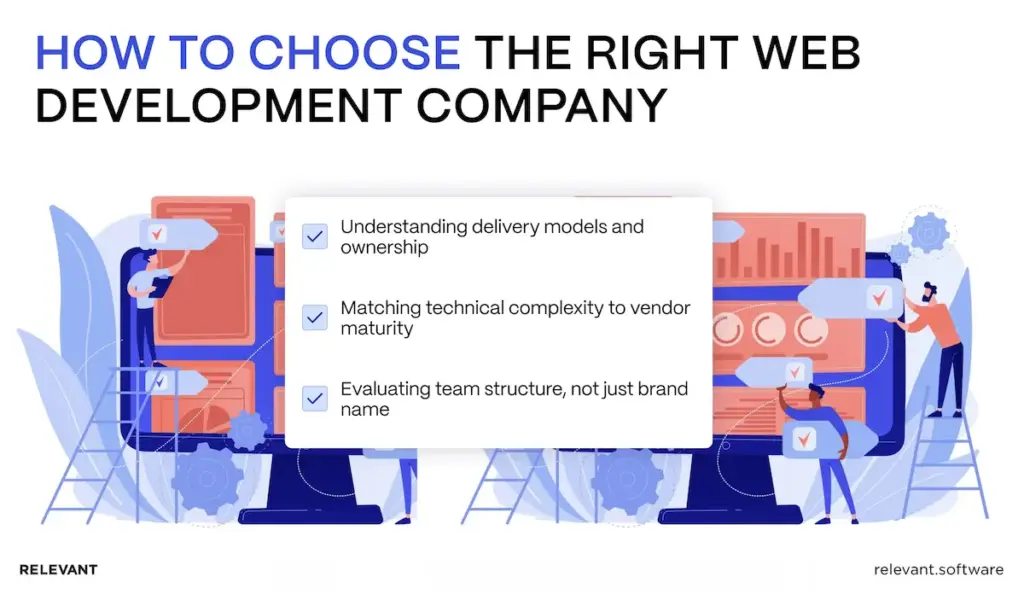
Matching technical complexity to vendor maturity
Start by defining the type of product you are building, because each category fails in different ways. A marketing site usually breaks down in performance and conversion. A workflow platform fails on permissions, data quality, and integrations. A revenue-critical platform fails on reliability and security, often at the worst possible moment.
Use this simple grouping:
- Marketing and brand site: CMS, analytics, SEO, accessibility, performance basics.
- Workflow platform: role-based access, approvals, dashboards, audit trail, system integrations.
- Core digital product: high traffic, payments, multi-tenant logic, strict uptime, complex data flows.
Then ask questions that reveal maturity fast:
- What performance targets will you commit to, and how will you measure them in production, including Core Web Vitals when relevant?
- Which OWASP Top 10 risks apply to this system, and what controls do you implement by default?
- What does “production-ready” include in your process: monitoring, alerting, rollback plan, web application penetration testing, and incident response?
If a vendor answers with concrete examples, metrics, and delivery artifacts, you are usually speaking with a mature team. If the answers stay at the level of tech stacks and tools, expect gaps to surface later in the delivery process.
Evaluating team structure, not just brand name
A portfolio shows what the company can deliver. The delivery team tells you what you will get. The goal is to confirm roles, seniority, and decision ownership before the contract locks you in.
Ask for clarity on:
- Named technical owner: who makes architecture calls and signs off on quality gates.
- Role coverage: front-end, back-end, QA, DevOps, plus product ownership alignment.
- Seniority mix: who writes core components, who reviews code, and how standards stay consistent.
- Communication rhythm: who runs planning, how risks surface, and how escalation works.
- Continuity plan: how they avoid key-person risk when someone rotates off the project.
If the vendor cannot define the team structure early, expect uncertainty to continue into delivery.
Understanding delivery models and ownership
Delivery models sound similar in proposals, but ownership differs widely. The difference between outsourcing models becomes apparent after launch, when incidents arise, priorities shift, and security patches compete with new features.
Typical engagement models:
- Project-based delivery: defined scope, clear acceptance criteria, planned handover.
- Dedicated team: evolving roadmap, continuous releases, long-term ownership.
- Team extension: internal leadership stays primary, partner adds execution capacity.
Regardless of the model, validate three ownership areas:
- Decision ownership: who owns architecture, security decisions, and tradeoffs.
- Quality ownership: who owns the test strategy, CI gates, and release readiness.
- Operational ownership: who owns monitoring, incident response, and post-launch fixes.
For security practices, NIST’s SSDF (Secure Software Development Framework) is a valuable baseline for checking whether secure delivery is systematic rather than ad hoc.
Red flags to watch during vendor selection
Red flags tend to sound reasonable in early calls, but they predict slow delivery and production pain. Look for gaps in specificity, ownership, and post-launch responsibility.
- No measurable targets: “fast” and “secure” without numbers, thresholds, or a monitoring plan.
- Security treated as a checkbox: OWASP vulnerabilities mentioned, but no concrete controls, testing approach, or patch policy.
- Thin QA story: heavy reliance on manual testing with no clear automation strategy tied to risk.
- Operational blind spots: no plan for observability, alerting, incident response, or handover.
- Discovery without decisions: workshops that produce slides, not acceptance criteria and scope boundaries.
- Unclear staffing reality: senior people appear in sales calls, but delivery roles stay vague.
A simple tie-breaker helps when two mobile app development companies look similar: ask each team to walk through a real production incident or delivery failure, what they changed afterward, and what they would do differently on your project. The best answers sound specific, calm, and practical.
Common mistakes companies make when choosing a web development partner
Vendor selection usually fails for a simple reason: teams evaluate what they can see, then suffer the consequences of what they did not validate. The safest way to avoid that trap is to frame each mistake as a concrete problem, then counter it with an equally concrete solution you can apply during selection.
Prioritizing cost over delivery predictability
The price looks objective, so it draws attention first. The risk shows up later, when the estimate quietly assumes away integrations, performance targets, test coverage, security fixes, and the operational work required after launch.
Problem: The project starts with an attractive number, but delivery loses predictability because the scope lacks boundaries and the vendor treats uncertainty as “out of scope.” That turns planning into a recurring renegotiation, and the team starts trading quality for speed to protect dates.
Solution: Use cost as the output of clarity. Ask vendors to define release acceptance criteria in writing, including non-functional targets, then explain how they handle scope change and what shifts the timeline and budget. Push for an explicit risk register with mitigation steps and a release plan that includes rollback and incident handling. When two proposals differ significantly, the one with more explicit assumptions usually better predicts reality.
Overlooking post-launch support and scalability
A launch introduces real traffic, real data, and real user behavior. Teams often treat support as a future conversation, then discover that nobody owns production stability when the first issues arrive.
Problem: The platform ships, and the team starts reacting rather than operating. Monitoring stays thin, ownership stays unclear, dependency upgrades wait too long, and performance drifts until users feel it. The backlog grows, and every new change becomes slower because the system lacks operational structure.
Solution: Treat “run” as part of delivery. Validate a monitoring and alerting plan, escalation rules, and a maintenance policy for dependency and security updates before development starts. Ask how the vendor protects real-user performance over time, including the metrics behind Core Web Vitals. Confirm ownership for incident response and post-launch fixes, because scalability depends on people and process as much as architecture.
Ignoring industry and compliance experience
Security and compliance requirements shape architecture. When teams postpone them, the platform absorbs hidden design debt that becomes expensive to remove.
Problem: The vendor ships features that pass internal demos, then fail external scrutiny. Access control lacks rigor, audit evidence stays incomplete, and remediation forces redesign at the worst time, often after data and workflows already depend on early decisions.
Solution: Bring compliance into design and delivery, not documentation. Ask the vendor to map your risks to OWASP Top 10 categories and explain the concrete controls they apply in code and infrastructure. Then ask how their delivery practices align with NIST SSDF expectations across the lifecycle, including who owns remediation when issues arise. The goal is simple: prove the team can produce audit-ready evidence without slowing delivery into a paperwork exercise.
Final thoughts
A vendor list becomes useful only after you narrow it to two or three serious candidates. If you keep ten options in play, the evaluation drifts into opinions and internal politics, because nobody can compare that many teams on objective evidence.
Use validation calls to test the areas that usually decide outcomes. Ask each team to walk through one recent delivery where the scope changed midstream, one release that introduced a regression, and one security or performance risk they managed under deadline pressure. Listen for specifics — what they changed, what they measured, and what they would do differently today. Confident but generic answers rarely predict real delivery behavior.
Then run a short paid pilot that reflects real work. Choose a small scope slice that includes an integration or a risky workflow, and requires concrete outputs: an architecture decision record, a test plan tied to risk, and a release approach that includes monitoring. If UI and UX carry real weight, align the pilot with web design services so design decisions and engineering decisions get validated together.