
Top Node.js Development Companies for Scalable Web and Backend Solutions
 Vadim StrukProduct Manager and Head of Business Analysis at Relevant Software
Node.js is one of those technologies that rewards good engineering habits. When the backend is well-designed, teams ship faster, integrations remain manageable, and real-time features feel effortless for users. Even better, a strong Node.js partner can keep releases calm as the product grows, so “scale” becomes a planned step rather than an emergency.
This guide shortlists the top Node js development companies for 2026 through a practical lens: production experience, architectural maturity, delivery practices, and fit for long-term roadmaps. It also helps teams determine whether they need end-to-end support from a broader software development company or a focused Node.js team that integrates with an existing engineering organization.
Comparison table: best Node.js development companies
A quick shortlist of the best Node js development companies becomes easier when key facts are in one place. The table below uses publicly available profile data and verified review snapshots, primarily from Clutch. Clutch explicitly positions its rankings around verified feedback and provider analysis, so it works well as a starting filter; a deeper evaluation should validate architecture skills and delivery practices.
| Company | Core services | Locations (HQ shown) | Clutch reviews | Notable clients (examples) | Pricing range* |
| Relevant Software | Node.js backend development, APIs, microservices, web platforms, DevOps, AI integration | L’viv (Ukraine), Warsaw (Poland), Valencia (Spain) | 4.9/5 | AstraZeneca, Volkswagen, Ossur | $50–$99/hr |
| Vention | Full-cycle custom software, cloud & DevOps | New York, NY, USA | 4.9/5 | EliseAI | $50–$99/hr |
| Apriorit | Node.js development, custom software, cybersecurity-focused engineering, QA/testing | Poznań, Poland | 4.9/5 | OPSWAT, Strivacity, Cryptonomic | $100–$149/hr |
| Designli | Node.js web apps, APIs, product design, UX/UI | Greenville, SC, USA | 5.0/5 | Behind the Knife | $150–$199/hr |
| AgileEngine | Boca Raton, FL, USA | 5.0/5 | Ford, Samsung, Airbus | $50–$99/hr | |
| Halo Lab | Web development, custom software, UX/UI, branding | Dubai, UAE | 4.9/5 | 46 Labs | $25–$49/hr |
| The Software House | Web and custom software, product delivery, consulting | Gliwice, Poland | 4.9/5 | StageClip, Travelia | $50–$99/hr |
| Fingent | Custom software, web apps, mobile delivery, cloud consulting | White Plains, NY, USA | 4.9/5 | Mastercard, Sony, PwC | $25–$49/hr |
| Lumitech | Custom software, UX/UI, web, and mobile development | Dubai, UAE | 5.0/5 | Reputable Health | $25–$49/hr |
| Osedea | Custom software, web development, UX/UI, AI services | Montréal, Canada | 4.9/5 | Rio Tinto, CAE, Kruger | $150–$199/hr |
*Pricing range = Clutch hourly rate bracket; final pricing varies by scope, team mix, and engagement model.
Why companies choose Node.js for backend development
Node.js stays popular because it supports fast delivery without forcing teams to trade reliability for speed. It works especially well for web applications and SaaS products that involve frequent API calls, frequent releases, and ongoing integration across cloud services, third parties, and legacy systems. The sections below connect Node.js strengths to the patterns that matter in production, so teams can judge fit for real digital products, not only prototypes.
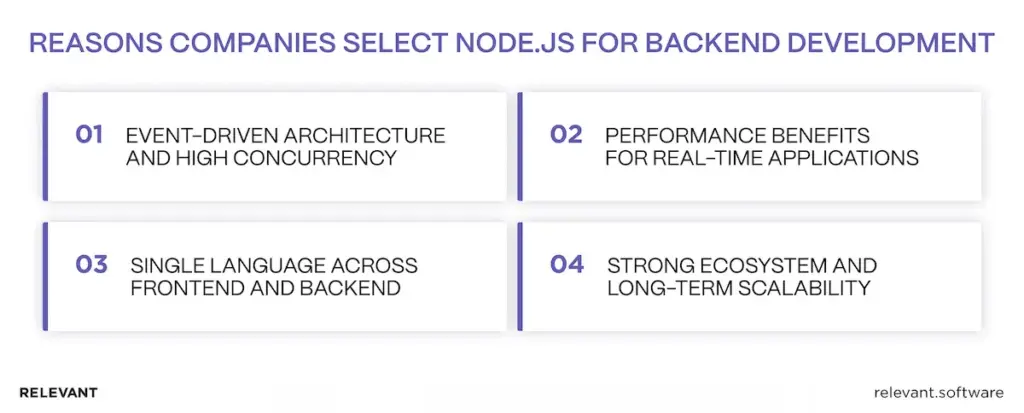
Event-driven architecture and high concurrency
Node.js uses an event loop that enables non-blocking I/O, so one service can keep many requests in progress while it waits for databases, networks, queues, or external APIs to respond. This approach often works well for scalable backend systems where the main bottleneck is I/O, not heavy computation.
Node.js tends to perform well in backend development when the system includes:
- API layers that orchestrate many calls per request, such as API gateways and BFF services.
- Integration-heavy flows in financial services, real estate platforms, and enterprise apps.
- Event processing with queues or pub/sub that absorb traffic spikes and smooth the load.
- Device and telemetry pipelines where a Node.js IoT development project must handle message bursts without stalling.
Production patterns that keep this model reliable:
- Clear timeout rules per dependency, so a slow service does not freeze the whole flow
- Idempotency for critical operations, so retries do not create duplicate orders, charges, or tickets.
- Backpressure controls ensure downstream systems remain protected during demand spikes.
Performance benefits for real-time applications
For many digital products, “performance” means stable response times under load, not theoretical maximum throughput. Node.js is well-suited to real-time applications because it handles many concurrent connections efficiently when the work centers on network I/O, events, and fast message exchange.
Common real-time use cases in web apps and mobile applications:
- Collaboration tools: presence, comments, live cursors, activity feeds
- Dashboards for digital transformation programs: live KPIs, operational telemetry, alerts
- Marketplaces: inventory updates, bidding, pricing rules, notification streams
- Customer support and ops tools: status updates that must stay responsive during peaks
A practical evaluation tip: ask how the development team will prove performance, not only promise it. Mature service providers define load targets, pick test scenarios tied to business goals, and include performance optimization in the development process before launch.
Single language across frontend and backend
A shared JavaScript foundation can help teams move faster in web development and app development, especially when frontend and backend change together. The best results come when the vendor treats the shared language as a productivity tool while still enforcing boundaries and code quality standards typical of serious software engineering.
Where the single-language approach adds business value:
- Shared API contracts and validation rules, which reduce mismatches and rework
- Faster onboarding across a distributed development team, including staff augmentation cases
- Consistent tooling for testing, linting, and CI across product development tracks
Where teams often lose time later:
- Weak boundaries that turn backend logic into a set of “helpers” without ownership rules
- Missing type discipline, which increases incident volume as the codebase grows
For complex systems, many vendors use TypeScript with strict API contracts to keep the backend readable over long roadmaps, even as team size grows and priorities shift.
Strong ecosystem and long-term scalability
Node.js has a mature ecosystem for custom software development across web frameworks, API development, queues, testing tools, observability, and cloud platforms. That matters for software development companies that support long-lived platforms, where upgrades, security work, and continuous improvement stay part of normal delivery.
A pragmatic “long-life” stack for Node.js development services often includes:
- TypeScript for safer refactors and easier maintenance over the years of experience.
- Structured logs, traces, and metrics for fast root cause analysis.
- Container deployment with clear resource limits per service on cloud platforms.
- Dependency scanning and secret controls are aligned with best practices for sensitive data.
API-first products also raise security needs early, especially around access control, auth, and partner integrations. OWASP’s API Security Top 10 provides a concrete checklist for threat modeling and test coverage during backend development.
How we selected the top Node.js development companies
This list helps teams select a reliable development partner for long-term application development, rather than a vendor chosen solely based on team size or hourly rate. We prioritized technical expertise, a proven track record, and delivery discipline that protect the user experience in complex products.
Selection filters used in this guide:
- Technical depth: clear architecture, standards, and ownership for business logic and high performance
- Complex platform experience: integrations, data engineering, regulated work, and real case studies
- Delivery maturity: strong project management, clear communication across time zones, stable governance
- Client validation: consistent reviews and long-term partnerships, not isolated wins
- Cloud readiness: CI/CD, monitoring, and incident response in real cloud environments
Top Node.js development companies (2026 list)
This section summarizes positioning, Node.js capabilities, and the best-fit profile for each firm. Use it as a shortlist tool, then validate it through a discovery sprint that delivers concrete outputs: architecture options, a risk register, a delivery plan, and a test strategy tied to failure modes.
If your roadmap overlaps with adjacent workstreams, it helps to cross-check partners through nearby lenses. Some teams evaluate the same vendors for AI delivery, so this list naturally pairs with the top AI software development companies. Others run Node.js as part of a mobile-first product strategy, so it can also help to review mobile app development companies during the shortlisting process.
Relevant Software
The first on our list of top Node.js development companies is Relevant Software, a vendor based in Ukraine that delivers to international teams. Founded in 2013, the company built expertise in Node.js backends, web platforms, DevOps, and AI integration for products that must stay stable as integrations grow.
- Core Node.js services: Node.js development services, custom web app development, API and microservices delivery, UI/UX design, AI integration, DevOps and CI/CD, CTO support.
- Industries served: Healthcare, energy, fintech, agriculture, and education.
- Engagement models: Dedicated team, time and materials, product discovery, advisory support via technology consulting services.
- What stands out: 92% senior talent drives clear architecture and disciplined releases for integration-heavy Node.js platforms. 98% client satisfaction reflects predictable delivery, stable code, and fewer late redesigns as requirements change.
- Best fit: Growth-stage startups preparing for scale, plus mid-market teams modernizing backend systems and adding services around an existing platform.
Vention
Vention is the best Node js development company based in New York, formerly known as iTechArt Group. Founded in 2002, the team supports full-stack product work for VC-backed startups and fast-growing tech companies that need scalable backend delivery.
- Core services: Full-stack development, Node.js backend work, web and mobile delivery, cloud and DevOps, QA, product consulting.
- Key industries: Fintech, SaaS, healthtech, digital platforms.
- Engagement models: Dedicated teams, team extension, project delivery, consulting.
- What sets them apart: A large global bench with structured delivery management, which helps multi-team programs keep scope, timelines, and reporting consistent.
- Best fit for: Mid-market and enterprise teams that run parallel initiatives and need dependable capacity with clear governance.
Apriorit
Apriorit is a top Node js development company founded in Dnipro, Ukraine, and later expanded to include a US headquarters and an EU presence. Founded in 2002, the team has built a strong reputation in security-focused engineering and complex software projects where risk control is critical.
- Core Node.js services: Node.js backend development, secure API development, architecture review, QA, DevOps support, modernization, and maintenance.
- Industries served: Cybersecurity, fintech, healthcare, and enterprise software.
- Engagement models: Dedicated team, time and materials, consulting, long-term support.
- What stands out: The company keeps security controls and change tracking within the main delivery flow, reducing late surprises during audits and production incidents.
- Best fit: Regulated platforms and security-sensitive products that need traceable changes and stable post-launch support.
Designli
Designli is a US-based Node.js development vendor headquartered in Greenville, South Carolina. Founded in 2012, the team focuses on turning early product ideas into a clear scope and then shipping web and app backends that remain easy to extend.
- Core Node.js services: Product discovery, Node.js backend development, API delivery, web and mobile development, UI/UX design, QA.
- Industries served: SaaS, marketplaces, consumer apps, and B2B platforms.
- Engagement models: Product discovery, project delivery, dedicated team.
- What stands out: Strong early planning and plain communication, which helps teams avoid scope drift and expensive rework halfway through the build.
- Best fit: Founders and product teams that need fast validation with a maintainable backend from version one.
AgileEngine
AgileEngine is a company headquartered in the Miami area, with delivery across the Americas, including Argentina. Established in 2010, the team covers custom software development, design, and broader product engineering support for long-term roadmaps.
- Core Node.js services: Node.js backend development, API development, team extension, QA, cloud support, and modernization.
- Industries served: Finance, eCommerce, and automotive.
- Engagement models: Team extension, dedicated team, long-term delivery.
- What stands out: AgileEngine integrates with existing standards and delivery processes, so the Node.js work follows the same rules as the in-house team, including reviews, testing, and releases.
- Best fit: Mid-market and enterprise teams that keep architecture ownership in-house and want reliable Node.js execution across many releases.
Halo Lab
Halo Lab is a design and development vendor with roots in Ukraine and a long track record with web products. Founded in 2013, the team pairs UI/UX expertise with full-stack delivery, which is especially useful when a product needs both a strong interface and a dependable backend.
- Core Node.js services: Web platform development, аull-cycle web application delivery paired with UI/UX, QA support
- Industries served: SaaS, eCommerce, digital platforms, and consumer products.
- Engagement models: Project-based delivery, dedicated teams.
- What stands out: Halo Lab pairs strong design execution with reliable backend delivery, helping teams ship cohesive releases. The approach reduces friction when UX changes affect the backend scope.
- Best fit: It fits product teams that want a design-forward approach while still shipping production web systems backed by Node.js services.
The Software House
The Software House is a Node. js-capable development company based in Poland. Founded in 2012, the team delivers custom web platforms with clear documentation and predictable collaboration, supporting multi-release work.
- Core Node.js services: Node.js backend development, web platforms, API development, cloud delivery, DevOps support, QA.
- Industries served: B2B platforms, marketplaces, and enterprise web systems.
- Engagement models: Dedicated team, project delivery, consulting support.
- What stands out: The Software House tends to excel at multi-release work, aiming to reduce “tribal knowledge” gaps, improve handovers, and maintain stable delivery as the platform grows.
- Best fit: Mid-market teams that want stable delivery for multi-release Node.js platforms.
Fingent
Fingent is a global software development company with offices across several regions and a headquarters in New York. With more than 20 years of experience, the team supports custom web and backend programs that often sit inside broader digital transformation work.
- Core Node.js services: Custom software development, Node.js backend delivery, modernization, system integration, QA, DevOps support.
- Industries served: Healthcare, finance, logistics, manufacturing, and enterprise operations.
- Engagement models: Outsourced delivery, dedicated teams.
- What stands out: Fingent fits environments where coordination drives the schedule, as the team is accustomed to integration-heavy programs with approvals, dependencies, and strict delivery expectations.
- Best fit: Enterprise and mid-market companies that need modernization plus a stable delivery partner across several releases.
Lumitech
Lumitech is a newer Node.js development vendor headquartered in Dubai with an engineering presence in Eastern Europe. Founded in 2022, the company positions itself as product-driven, a stance that often resonates with startups that need speed and clear ownership.
- Core Node.js services: Backend APIs for web and mobile products, early architecture setup for new platforms
- Industries served: SaaS, marketplaces, consumer apps, and startup products across industries.
- Engagement models: Product discovery, time and materials, dedicated team.
- What stands out: A delivery style that keeps scope organized while moving quickly, which helps teams build a foundation that can handle new services and higher traffic later.
- Best fit: Growth-stage startups that need momentum now and a backend foundation ready for scale and integration growth.
Osedea
Osedea is a Montreal-based innovation and software company. Founded in 2011, the team blends product design and engineering, which helps when an initiative starts with uncertainty and needs strong discovery before delivery.
- Core Node.js services: Product engineering and backend services for digital platforms
- Industries served: Enterprise innovation, regulated industries, and digital transformation programs.
- Engagement models: Discovery plus delivery, consulting, dedicated product team.
- What stands out
Best when the engagement demands senior decision-making, strong discovery, and polished product execution. - Best fit: Enterprise transformation teams and product orgs that need a partner comfortable with ambiguity, stakeholder alignment, and long-lived backend quality.
How to choose the best Node.js development company for your project
Vendor selection gets easier once the evaluation moves from “Can they code?” to “Can they keep this system stable while it grows?” The sections below map the most common decision points to what you can verify in calls, documents, and a short pilot.
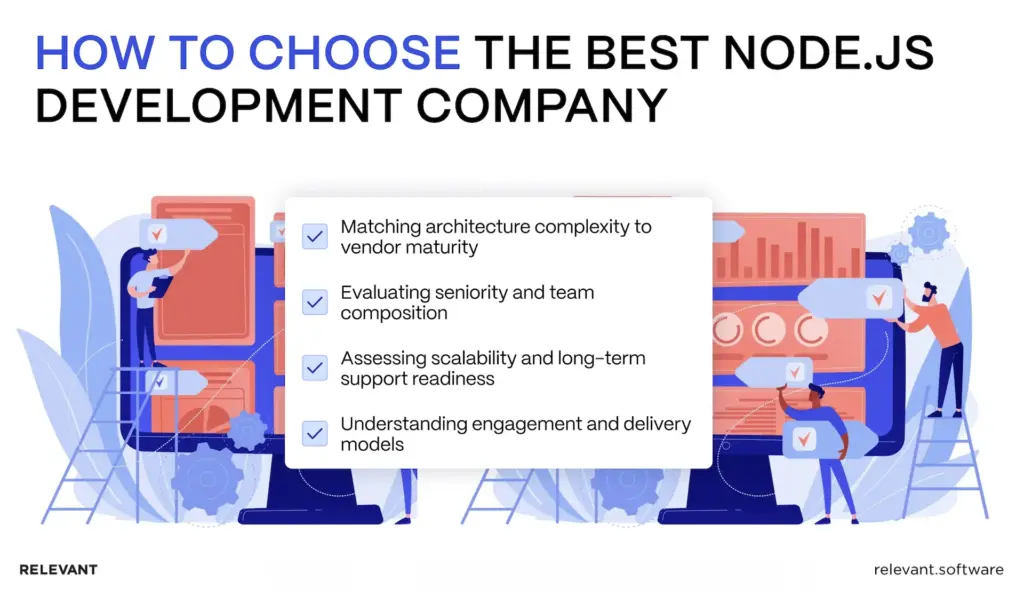
Matching architecture complexity to vendor maturity
Start by naming the real complexity in your product. Many Node.js projects look simple on the surface, then grow sharp edges through integrations, permissions, billing rules, and data workflows. A mature vendor will ask for your busiest flows, the riskiest dependencies, and where data consistency matters.
Use a few quick checks:
- Ask how they would split services for your domain, and what they would keep in a single codebase early
- Request examples of similar systems they supported after launch, not only how they built them
- If your scope includes desktop delivery, confirm experience with a Node js desktop app and packaging, updates, and OS-specific edge cases
Evaluating seniority and team composition
“Senior” should mean more than years on a CV. You want people who can explain trade-offs, prevent rework, and ensure consistent delivery decisions across multiple releases. Ask who owns architecture decisions, who reviews critical PRs, and how the team handles disagreements.
What to verify:
- A named technical lead who stays accountable through release and post-launch fixes
- Clear roles for QA, DevOps, and product communication, not a single developer doing everything
- Evidence of onboarding speed: how they learn a domain and make progress without breaking core flows
Assessing scalability and long-term support readiness
Scalability is rarely only about traffic. The harder test is how a platform behaves under change: new integrations, dependency upgrades, schema migrations, and multiple teams touching the same services. Strong partners plan observability early and have a realistic approach to incident response.
Look for:
- A monitoring plan: which metrics matter, where alerts trigger, and who responds
- Clear release mechanics: rollback steps, safe migrations, and feature rollout control
- A post-launch plan: security updates, dependency maintenance, and performance tuning cycles
Understanding engagement and delivery models
A vendor’s delivery model matters as much as engineering skill. Some teams need end-to-end ownership, while others need reliable capacity that fits into an existing process. In both cases, you want an agile approach that preserves clarity: how scope changes are approved, how progress is reported, and how risks are surfaced early.
Common models to compare:
- Dedicated team: best for long roadmaps and ongoing ownership
- Time and materials: best when the scope evolves, and priorities shift often
- Discovery phase: best for reducing early uncertainty before full build
- Advisory support: best when internal teams deliver, but architecture and delivery decisions need senior guidance
A helpful rule: if you want end-to-end ownership, Node.js development services fit that path. If you already have leadership and need extra capacity, it can make more sense to hire Node.js developers.
Questions to ask top Node js developers during evaluation
Before you compare top Node.js developers, it helps to align on fit. A quick read on when to use Node.js can save time during shortlisting, especially if the workload is CPU-bound rather than I/O-heavy. You may also want a baseline on what a strong full-stack developer for Node.js should cover, since many teams hire for “full-stack” but still need clear backend ownership.
These questions force specifics and reveal how a team thinks:
- Show a recent Node.js service you shipped: what was the traffic peak, payload size, and p95 latency after launch?
- How do you handle background jobs and scheduled tasks in Node.js, and how do you make them observable?
- Show an example of a production incident you handled: what broke, how you detected it, and what changed afterward?
- How do you release safely: canary, blue-green, feature flags, or something else? What is the rollback playbook?
- If this is a Node.js for IoT development project, how do you handle device spikes, message ordering, and offline retries without corrupting data?
If answers stay vague, the vendor may lack production-scale experience.
Common mistakes when hiring a Node.js development company
Even strong teams make predictable hiring errors under schedule pressure. These mistakes rarely look dramatic at the start, but they surface later as missed deadlines, surprise refactors, and production headaches. The goal is to identify the risks now, while you still have time to prevent them.
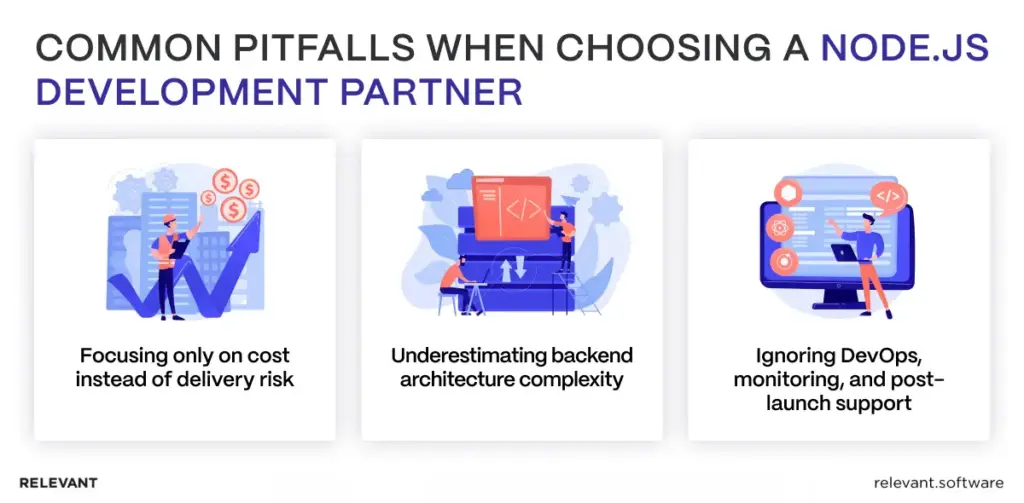
Focusing only on cost instead of delivery risk
Comparing vendors by hourly rate feels objective, but it hides the real cost drivers: rework, unclear ownership, unstable releases, and slow feedback loops. A lower rate becomes less attractive once the backend requires repeated fixes after every change.
A safer selection process shifts the discussion from price to proof:
- Run a short discovery phase and require tangible outputs such as an architecture note, a risk list, and a delivery plan
- Ask for evidence of production practices like CI/CD, observability, and runbooks, with examples from past work
- Test communication under pressure by walking through a realistic scenario, such as an incident during peak traffic
Underestimating backend architecture complexity
Many products start simple, then grow through integrations, permissions, billing, analytics, and reporting. Node.js supports high concurrency and fast I/O, but it cannot compensate for fuzzy service boundaries or weak data ownership. When the architecture discipline slips, the platform becomes harder to change and easier to break.
Watch for clear red flags:
- No service boundaries and no API versioning plan
- Unclear data ownership across services and teams
- No performance plan for load testing, capacity forecasting, and bottleneck analysis
If a vendor cannot explain these topics in plain language, the risk usually shows up later as outages, slowdowns, and expensive rewrites.
Ignoring DevOps, monitoring, and post-launch support
Shipping to production marks the start of the hard part, not the finish line. Real users bring real traffic patterns; third-party services fail; dependencies require upgrades; and incident response becomes part of the operating model. If the vendor treats this as “support later,” your team ends up carrying the operational load.
Make post-launch responsibilities explicit before signing:
- Who owns production monitoring and alerts, and what triggers escalation?
- Who runs incident response and root cause analysis, and how fast?
- How do fixes move from hot patch to stable release without creating more risk?
- What does the support SLA cover, and where are the boundaries?
Final thoughts on selecting a Node.js development company
When searching for a reliable collaborator, it is easy to feel overwhelmed by endless options, mixed claims, and noisy pricing comparisons. This article helps narrow the field and identify the teams that align with your goals, delivery expectations, and technical needs. The ideal partner matches your product stage, understands your domain, and has enough relevant experience to support the roadmap without constant rework.