
Top Mobile App Development Companies: 2026 Guide to the Best Global Teams
 Vadim StrukProduct Manager and Head of Business Analysis at Relevant Software
By early 2025, mobile phones reached 5.78 billion people globally, with smartphones now close to the default at almost 87% of active devices. Over the past year, users logged 4.2 trillion hours in iOS and Google Play apps, which Sensor Tower estimates at around 3.5 hours per day per mobile user. That time now covers everything from banking and healthcare to grocery runs and side projects, so for many companies, the “app” is no longer a channel. It is the product, and the team behind it directly impacts revenue, customer trust, and daily operations. This guide helps with choosing that unique team. It explains the criteria used to select top mobile app development companies and shows what a reliable partner looks like in practice.
You get a clear view of strengths, industries, and engagement models, so your shortlist reflects deliberate choices, and you can choose mobile app development services from the provider that fits your product best.
Comparison table: best mobile app development companies
Before diving into profiles, it helps to see the landscape at a glance. The table below focuses on mobile work, geography, social proof, and typical budget levels, so CTOs or product leads can see which mobile app development companies have the best client reviews in 2025.
| Company | Core mobile services | Locations | Clutch reviews (approx.) | Notable clients* | Typical pricing range** |
| Relevant Software | Native iOS/Android, Flutter, React Native, backend, UX/UI/, cloud, AI, IoT | HQ in Ukraine, offices in Poland and Spain | 4.9 / 5 from 30+ reviews | AstraZeneca, Volkswagen, Norwegian | Mid-range, often $50–$99/hr for product teams |
| Cheesecake Labs | Product discovery, mobile apps, web apps, blockchain, UX/UI | The US and Brazil | 4.9 / 5 from 60+ reviews | Mercado Libre, Singularity University, AES | Mid to upper mid-range, many projects $50k–$200k |
| Suffescom Solutions Inc | Custom mobile apps, web, blockchain, and AI | The US, UK, India, and others | 4.9 / 5 from 100+ reviews | Universal, NBC, University of Alberta | Value range, often $25–$49/hr for long-term teams |
| Droids On Roids | Native apps, Flutter, product design, QA | Poland | 4.8+ / 5 from 50+ reviews | Giphy, NCC, Unilever, Electric Objects | Upper mid to premium, often $75–$149/hr |
| TechAhead | Mobile, IoT, cloud, AI, consulting | The US and India | 4.9 / 5 from 110+ reviews | Audi, Disney, American Express | Value to mid-range, often $25–$49/hr |
| ArcTouch | Strategy, design, native apps, wearables, connected devices | The US (multiple offices) | 4.9 / 5 from ~35–40 reviews | Audi, 3M, NBC, Hawaiian Airlines | Premium, often $100k+ projects and $50–$149/hr |
| STRV | Product strategy, design, mobile, backend | The US and the Czech Republic | 4.9 / 5 from 70+ reviews | Tinder, Porsche, The Athletic, Barry’s | Premium, many engagements $100k+ |
| Designli | Product definition, UX/UI, mobile development | The US | 5.0 / 5 from 70+ reviews | Michelin, Hearst, EarthLink | Mid-range, common budgets $50k–$150k |
| Hyperlink InfoSystem | Mobile, CRM, enterprise solutions, AI | India, US, UK, UAE | 4.9 / 5 from 1,000+ reviews across offices | Google, Disney, Papa John’s | Broad spectrum, from lower-cost to mid-range |
| WOLFPACK DIGITAL | Product strategy, UX, mobile, cloud backend | Romania | 4.9 / 5 from 50+ reviews | Sephora, Deezer, Transreport | Mid-range, often $50–$99/hr |
* Info based on public case studies and partner directories.
** Ranges come from Clutch and vendor sites; always confirm with a fresh quote.
Evaluation criteria for mobile app development companies
The criteria below help filter the best mobile app development companies that ship one good release from those that run a product for years without chaos.
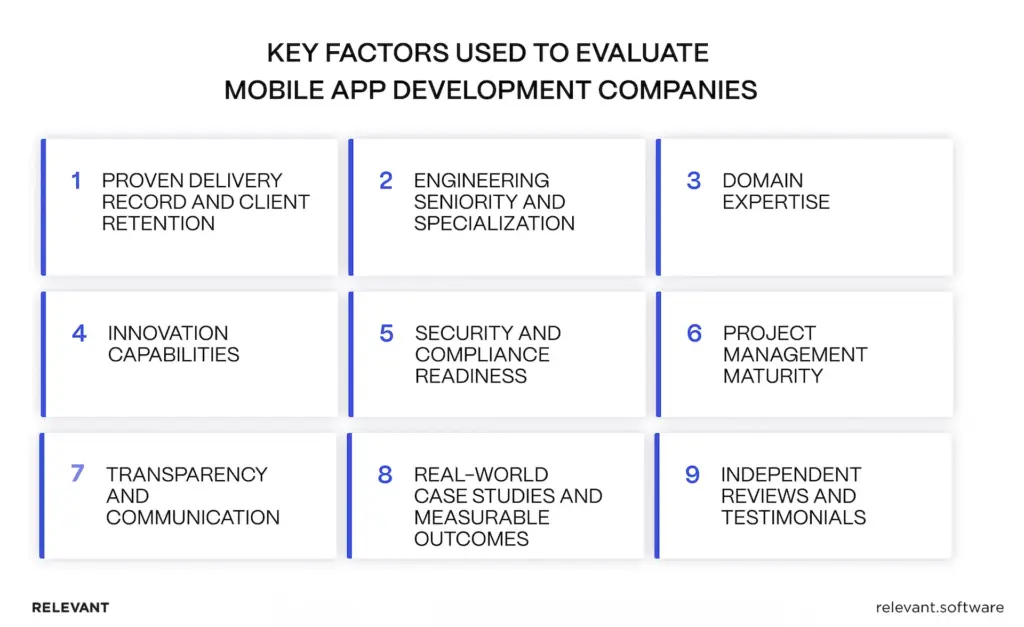
Proven delivery record and client retention
Look for patterns in delivery, not one glowing quote.
- Check review depth, not only the score. Long, specific Clutch reviews with measurable outcomes beat short “great team” comments every time.
- Ask about multi-year clients. If they are still working with the same product teams three years later, that signals high customer satisfaction.
- Request references from similar engagements. Ideally, the same industry and a similar budget.
Engineering seniority and specialization
The best mobile app development company fills the team with senior engineers where it matters and proves it.
- Ask for team composition by seniority on your account, not across the whole firm.
- Confirm platform depth for iOS, Android, and cross-platform frameworks, plus backend, DevOps, and QA.
- For complex apps, consider staff augmentation options so their engineers can embed with your teams as needed.
Domain expertise
When you shortlist top mobile app development companies, domain expertise matters more than portfolio screenshots.
- Fintech: Ask whether the team has shipped apps with KYC and AML flows, strong authentication, and reliable transaction monitoring, since these details often drive the architecture.
- Healthtech: Look for HIPAA-ready designs and real delivery experience with remote patient monitoring or medical devices, where privacy controls and audit trails must stay consistent.
- Logistics, eCommerce, and IoT: Prioritize mobile phone app development companies that can prove ERP, WMS, and payment gateway integrations, plus stable links to device fleets across weak networks and high-volume events.
To provide a broader context for how mobile apps help in digital transformation, this overview explains why digitalization works and how to approach it step by step.
Innovation capabilities (AI/ML, cloud-native, cross-platform)
Modern apps rarely stand alone. They run on cloud-native stacks, rely on data, and often include AI features somewhere in the workflow.
- Check whether the top mobile app development company builds AI-powered features such as recommendations, chatbots, or anomaly detection, not only “basic analytics.”
- Confirm their experience with cloud providers (AWS, Azure, GCP) and event-driven designs.
- Assess their mobile app development solutions for cross-platform delivery, especially with Flutter and React Native, where build pipelines and QA can make or break quality.
Security and compliance readiness
Mobile products sit close to payments, identity, and sensitive personal data, so security requirements cannot live in a slide deck.
- Ask how they implement OWASP Mobile best practices, secrets management, and secure storage.
- Confirm experience with GDPR and, where needed, HIPAA and PCI DSS.
- Check whether they conduct regular security testing and work with external auditors when required by regulations.
Project management maturity
Calm delivery usually comes from boring, repetitive routines. That is a compliment.
- Look for Agile delivery that still respects budget and scope, rather than “we are agile, so dates are flexible.”
- Ask how they combine DevOps, QA automation, and release management for mobile, web, and backend.
- Request a sample delivery roadmap from a past mobile engagement of a similar size.
Transparency and communication
Most mobile projects fail in conversation, not in code. When you choose a top mobile application development company, treat communication as a deliverable and qualify it the same way you would the architecture.
- Ask who joins weekly status calls and who actually makes decisions.
- Confirm direct access to tech leads and designers, not only account managers.
- Clarify how they handle bad news, such as delays or blocked dependencies. You want fewer surprises and more specific mitigation plans.
Real-world case studies and measurable outcomes
A slide with five logos is nice. A case study with concrete numbers is better.
- Look for metrics such as crash-free rate, app store rating changes, conversion lifts, or operational savings.
- Ask for post-launch support stories, not only build-and-hand-off projects.
- Pay attention to before/after narratives, especially around retention and revenue.
Independent reviews and testimonials
Platforms like Clutch and G2 exist for a reason. Use them.
- Scan reviews for themes: communication, predictability, technical depth, and willingness to push back when needed.
- Check how vendors respond to criticism, not only praise.
- Compare their profile to other application development companies in the same budget bracket to see whether they over-promise or keep claims modest.
Top 10 mobile app development companies
We selected these 10 mobile app development companies because they consistently earn attention across rankings and directories and back it up with client reviews. They represent different regions, cost profiles, and vertical experience, which lets you shortlist vendors that align with your product context instead of chasing an abstract “best mobile app development company.”
Each profile includes a quick overview of the best mobile app development companies for startups and enterprises, where they fit best, what they actually ship on mobile, and why teams like yours tend to work with them.
Relevant Software
Relevant Software is a European mobile app development company that often works as an external product team rather than a one-off contractor. The company focuses on complex, long-lived products in which mobile, backend, and data sit on a single roadmap, with a heavy emphasis on AI, predictable delivery, and calm collaboration.
- Key industries served. Fintech, healthtech and medical devices, proptech and real estate, logistics and retail, IoT and connected products.
- Core mobile capabilities. Native iOS and Android, Flutter and React Native, cross-platform development, cloud backends and APIs, integrations with IoT devices, AI, and analytics platforms with secure architectures.
- Engagement models. Dedicated product teams and team extension, time and material for evolving products, fixed price for clearly defined discovery or MVP work.
- Why they stand out. For companies that want a long-term product partner instead of changing freelancers, Relevant works more like an extension of their team than a typical outsourcing vendor. They bring structured discovery, clear roadmapping, and the best mobile app developers that handle strategy, design, and delivery under one roof, reducing the “who owns this decision” confusion that can slow down mobile app development.
Cheesecake Labs
Cheesecake Labs is a Brazilian and US-based mobile application development company that combines product strategy, UX, and engineering. The team often supports North American and European clients seeking nearshore delivery, with strong English communication and a design-led approach.
- Key industries served. Fintech and payments, marketplaces and platforms, telecom, mobility and logistics, media and content.
- Core mobile capabilities. iOS and Android, Flutter and React Native, API and backend services, UX and UI for consumer-grade products, blockchain integrations for Web3 and digital asset projects.
- Engagement models. Long-term dedicated teams, time and material for growth-stage products, fixed price discovery, and UX work before build.
- Why they stand out. Cheesecake Labs tends to shine when a product team values design quality as much as technical execution. Reviews highlight senior engineers on projects of all sizes, strong communication skills, and the ability to work within existing engineering structures without creating “us vs them” dynamics.
Suffescom Solutions Inc
Suffescom Solutions is a large mobile software development company with offices in the United States, India, and several other regions. The firm covers a broad spectrum of services, from mobile and web apps to blockchain and AI products, which suits organisations that want to explore several technology tracks with one vendor.
- Key industries served. Fintech and trading platforms, healthcare and wellness, gaming and entertainment, transportation, on-demand services, and eCommerce.
- Core mobile capabilities. Native and cross-platform apps, mobile wallets and trading apps, blockchain-enabled applications, AI-enhanced features, UX and UI for consumer products, backend and API development.
- Engagement models. Large distributed teams for extensive roadmaps, time and material for ongoing products, fixed price for well-scoped features, and proof-of-concept work.
- Where they stand out. Their top app developers cover a wide range of domains, which suits teams that want to validate multiple product directions or pivot between web, mobile, and Web3 without switching vendors. If your backlog mixes core mobile development with blockchain pilots and AI-driven features, this breadth allows you to keep a single delivery partner while you test, learn, and re-prioritise.
Droids On Roids
Droids On Roids is a Poland-based mobile app development company with a strong reputation for native and Flutter work. They position themselves as a focused delivery partner that covers strategy, design, engineering, and QA for mobile-first products.
- Key industries served. Consumer apps, media and entertainment, mobility and transportation, health and fitness, hardware and IoT-enabled products.
- Core mobile capabilities. Native Android and iOS, Flutter development and migration from legacy stacks, UX and UI design, backend and DevOps support, ongoing maintenance and optimisation.
- Engagement models. Dedicated feature teams, time and material for continuous development, fixed price for MVPs, and well-bounded projects.
- Where they stand out. Droids On Roids tends to appeal to teams that want strong engineering discipline and an obvious delivery rhythm. They communicate clearly, make decisions based on data, and ship regularly instead of treating each release as a big event.
TechAhead
It is a global mobile app development company with delivery centres in India and a strong client base in North America and Europe. The company focuses on mobile, cloud, AI, and IoT, and often appears on shortlists for enterprises seeking a single partner across multiple digital initiatives.
- Key industries served. Real estate and proptech, fintech and insurance, retail and eCommerce, healthcare and wellness, logistics and field operations.
- Core mobile capabilities. Native and cross-platform apps, AI-enhanced features, IoT and sensor integrations, cloud-native backends, analytics and dashboards, UX and UI for both consumer and enterprise experiences.
- Engagement models. Dedicated teams for multi-year programmes, time and material for evolving products, and fixed price for scope-limited work such as pilots or MVPs.
- Where they stand out, TechAhead offers a wide range of services and proven experience with large, IoT-driven platforms. When your mobile product connects to devices, cloud systems, and analytics, it can design beyond the app itself and make architecture decisions that support long-term growth.
ArcTouch
ArcTouch is one of the more established names among top mobile app development companies, with roots in the early days of the App Store. Now part of the AKQA network, the company focuses on mobile apps, websites, and connected experiences for well-known brands.
- Key industries served. Automotive and mobility, media and broadcasting, travel and hospitality, retail and loyalty programmes, smart devices and wearables.
- Core mobile capabilities. Native iOS and Android, design and UX research, connected device and wearable apps, cross-platform development, product evolution, and optimisation
- Engagement models. Strategy and discovery engagements, end-to-end product design and delivery, long-term evolution and maintenance agreements.
- Where they stand out. ArcTouch is a good fit for organizations that value design, brand, and customer experience as much as engineering. It has experience with complex ecosystems, from in-car systems to loyalty apps, and plans beyond launch, focusing on what comes next.
STRV
STRV is a digital product company with offices in Europe and a significant footprint in the United States. The team designs, builds, and scales mobile and web products for well-known brands and high-growth startups, with a portfolio that includes sports, fitness, and social products.
- Key industries served. Sport and fitness, social and dating, entertainment and media, retail and marketplaces, fintech.
- Core mobile capabilities. Native iOS and Android, React Native and Flutter, product strategy, UX and UI, backend and cloud services that support real-time, data-rich experiences.
- Engagement models. End-to-end product teams for long-term work, time and material for continuous improvement, and fixed scope for discovery or smaller initiatives.
- Where they stand out. STRV tends to excel in categories where user engagement and polish decide whether the app stays on the home screen. Their work with brands like Barry’s and The Athletic shows they know how to handle high expectations on both UX and performance without making the engineering side feel like an afterthought.
Designli
Designli is a US-based mobile app development company that specialises in turning an idea into a working product. They frame themselves as a long-term product partner, with dedicated teams that stay with the same client rather than jumping between multiple accounts.
- Key industries served. Fintech and professional services, healthcare and wellness, logistics and field operations, SaaS and internal tools, marketplaces.
- Core mobile capabilities. iOS and Android development, React Native cross-platform apps, companion web apps and admin panels, UX workshops, roadmapping, and interface design.
- Engagement models. Dedicated product teams that focus on one client, time and material for living products, and a fixed price for discovery or first-release builds.
- Where they stand out. Designli suits leaders who need help with the “what” and the “why” as much as the “how.” They spend a lot of time on product definition and user journeys, which reduces the chance you end up with an app that looks nice, passes QA, and still fails to solve a real problem.
Hyperlink InfoSystem
Hyperlink InfoSystem is a large India-headquartered mobile application development company with offices in the US, UK, and other regions. The firm has delivered thousands of projects across mobile, web, and custom software, and often appears on lists of top app development companies in multiple geographies.
- Key industries served. eCommerce and retail, media and entertainment, enterprise and internal tools, healthcare and fitness, education and on-demand services.
- Core mobile capabilities. Native iOS and Android, Flutter and React Native, integration with CRM and ERP systems, AR and VR features, analytics, and reporting around mobile usage.
- Engagement models. Broad range from small, fixed-price apps to large, ongoing teams; time-and-material for continuous work; dedicated teams for enterprise clients.
- Where they stand out. Hyperlink InfoSystem combines scale, breadth of technology, and a wide range of pricing. They fit situations where a company wants to explore several application development companies, yet prefers a partner that has likely seen a similar idea before and can speak from experience rather than theory.
WOLFPACK DIGITAL
WOLFPACK DIGITAL is a Romanian web and mobile app development company that positions itself as a start-to-end partner. The team wins design and technology awards and focuses on building integrated systems where mobile apps, web apps, and backend services align with business goals.
- Key industries served. Fintech and banking, healthtech and wellness, mobility and transportation, beauty and lifestyle, and greentech.
- Core mobile capabilities. iOS and Android apps, cross-platform development, UX and UI, product and business strategy, backend and DevOps, AI integration for selected use cases.
- Engagement models. End-to-end delivery teams, time-and-materials for evolving products, ongoing support, and post-launch optimization.
- Where they stand out. WOLFPACK DIGITAL pays close attention to visual quality and product performance while maintaining a pragmatic view of scope. They like to talk about “balanced” products that meet business goals and keep users happy, which sounds simple, though very few mobile development companies consistently manage that balance in production.
Once independent reviews narrow the list to teams that deliver what they promise, the question changes from “who can build this” to “who can build what we will need next.” At that point, you need to see whether those mobile app development companies design for where the market is going, not where it was five years ago.
The following section looks at the trends that already shape how leading teams architect, ship, and scale mobile products in 2026.
Which trends will shape the top mobile app developers in 2026?
Mobile keeps moving faster than most roadmaps. A mature mobile application development company tracks these shifts. It has real projects to show for them, whether it is a digital transformation company in New York or an app development agency in San Francisco.
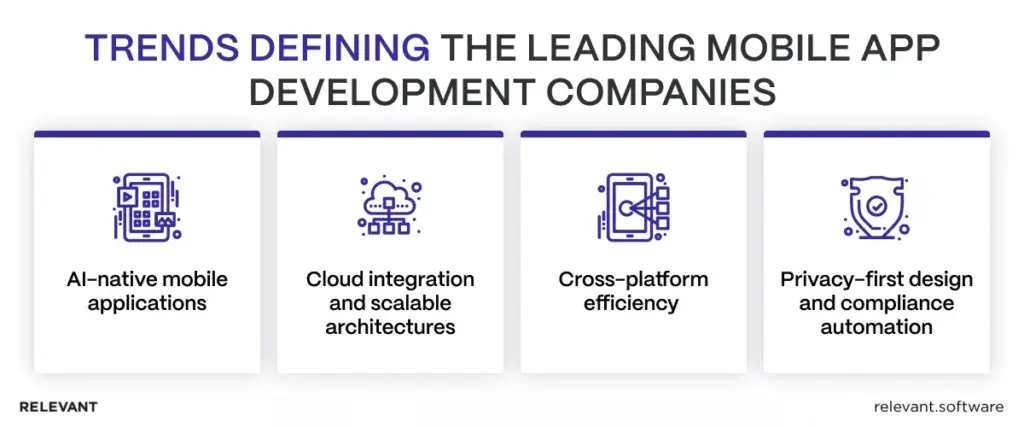
AI-native mobile applications
Artificial intelligence and machine learning no longer appear as side features. They sit behind search, keyboards, support flows, and content ranking, and quietly reset what users see as a normal user experience. Conversational interfaces, personalised feeds, and context-aware assistants already account for billions in consumer spend, so products that skip this layer start to feel static next to modern mobile app solutions.
The better mobile application development companies treat AI as part of the architecture. They define which decisions models handle, which risks humans still own, how data flows through the system, and how failure modes look in production. In practice, that means artificial intelligence that accelerates tasks and decisions while the interface stays predictable. For partner selection, this overview of the top AI software development companies gives a valuable benchmark.
Cloud integration and scalable architectures
Strong mobile apps feel fast and lightweight because most of the heavy processing happens in a well-designed cloud backend. Instead of relying on one extensive system behind the app, modern solutions use event-driven architectures, managed services, and precise monitoring. Mobile engineers, DevOps, and SRE teams usually work as one group, discussing performance, reliability, and cost together.
When backend work is delayed, growth quickly exposes the gaps. Enterprise mobile app development plans for scale, failure handling, and rollout from day one. Leading teams can clearly explain which parts of the system scale smoothly, which become bottlenecks, and how those choices affect operating costs and long-term software strategy.
Cross-platform efficiency (Flutter dominance)
Cross-platform development is no longer just a cost-saving choice. Frameworks like Flutter and React Native allow teams to build iOS and Android apps in parallel, keep design systems consistent, and avoid maintaining two separate codebases. This becomes important when teams release updates frequently, run experiments, and coordinate multiple teams around a single product roadmap.
Top companies for mobile app development still rely on native code for areas such as payments, advanced media, and device-specific features, while a cross-platform layer ties everything together. Strong app development partners define clear boundaries between native and shared layers, test them carefully, and avoid the “write once, debug forever” problem. For features that must feel truly native on Apple devices, dedicated iOS application development remains part of a well-balanced cross-platform approach.
Privacy-first design and compliance automation
Privacy is no longer just a legal formality. It now shapes product design and system architecture. Users may skip privacy policies, but they notice unnecessary permission requests and forms that ask for more data than they feel is reasonable. Product teams that take privacy seriously collect fewer data points, explain each permission in clear language, and map user journeys to data flows early in the design process, which makes life easier for UX designers and app design teams across mobile and web applications.
Behind the scenes, consent management, data minimisation, and “right to be forgotten” processes are no longer handled through scattered custom code. They are built into shared services, policy engines, and automated pipeline checks. This reduces regulatory risk and removes friction for engineering and IT teams. Clear mobile UI guidelines, then turn compliance rules into practical, user-friendly interaction patterns instead of abstract requirements.
Final takeaway: choosing a long-term app partner
Choosing among the top mobile app development companies can be hard at first because so many portfolios look similar. The fundamental differences appear in how teams behave after the launch party ends, and the roadmap becomes everyday work.
A strong partner does three things at once:
- Saves budget in the long term by reducing rework, technical debt, and failed experiments, not only by lowering hourly rates.
- Reduces risk through predictable delivery, clear communication, and serious attention to security and compliance.
- Accelerates product growth by pairing mobile engineering with strategy, analytics, and ongoing UX improvements, so each release genuinely moves business metrics.
When vendor selection is seen as the start of a long-term partnership, not a one-time build, the shortlist becomes more transparent and easier to justify. A practical way to test that fit is to begin with mobile app consulting services and use that phase to evaluate readiness for a long-term product partnership.