
Top 10 iOS App Development Companies Trusted for iPhone Apps
 Vadim StrukProduct Manager and Head of Business Analysis at Relevant Software
iOS remains one of the most valuable platforms for products that need high trust and strong user experience, from consumer subscriptions to enterprise workflows. That is why iOS app development companies matter more than many teams expect.
Apple’s own data shows how quickly the platform evolves. In 2025, iOS 18 was running on 82% of iPhones making App Store purchases, and on 88% of iPhones released in the past four years. When the platform moves this fast, your development partner directly affects how reliably you can ship updates, keep the app stable across real devices, and respond quickly when users report issues.
This guide highlights the top iOS app development companies (2026 edition), explains what to verify during evaluation, and includes a vendor selection checklist to help teams shortlist faster and compare partners on a common baseline.
Comparison table: best iOS app development companies
Before the deeper profiles, the comparison table below gives a quick scan of iPhone apps development companies – who does what, where they operate, how reviewers rate them, and the typical pricing range. Use it to narrow your shortlist in minutes, then read the company sections to validate fit by industry, delivery model, and release discipline.
| Company | Core services | Locations | Clutch reviews | Notable clients | Pricing range (avg hourly) |
| Relevant Software | iOS development, Swift, backend/API, UX/UI, QA, DevOps | L’viv, Warszaw, Valencia | 4.9 | AstraZenecaVolkswagen, FirstHomeCoach, Össur | $50–$99/hr |
| Andersen | iOS, enterprise mobile, QA, design, cross-platform | Warszaw | 4.9 | Siemens, Ryanair, TUI | $50–$99/hr |
| Empat | iOS, product discovery, UX, mobile + web | San Francisco | 5.0 | Porsche, Panasonic | $55–$99/hr |
| AppMakersUSA | iOS, design, app modernization, support | LosAngeles | 5.0 | CVS Pharmacies, National Football League, Los Angeles Apparel | $50–$99/hr |
| Atta Systems | iOS, mobile, UX/UI, custom software | București | 5.0 | EupnoosMedicaiBold Health | $50–$99/hr |
| EB Pearls | iOS, product design, delivery + support | Surry Hills (AU) | 5.0 | FlipPayParperaAFEA | $25–$49/hr |
| Suffescom Solutions Inc | iOS, mobile, MVP delivery, support | Mohali, Punjab | 4.9 | Sun Shine Ride ShareMarqadeNeighborly Rideshare | $50–$99/hr |
| Droids On Roids | iOS + product delivery, QA, DevOps | Wrocław | 4.9 | GIPHY, Carlsberg, CCC Shoes | $50–$99/hr |
| Ackee | iOS + Android, backend, QA, analytics | Karlín | 5.0 | ShipmonkWWFKVIFF | $50–$99/hr |
| JPLoft | iOS, cross-platform, backend, QA | Denver | 5.0 | TruuBlue LLC | $50–$99/hr |
What defines the best iOS mobile app development companies
A capable iOS app development company protects two things at the same time: the user experience people see today, and the codebase your team must live with next year. That balance shows up in small, practical decisions, not in big promises. The best signal is simple: the vendor can explain how it ships, measures quality, and improves the app after release, with real examples from recent work.
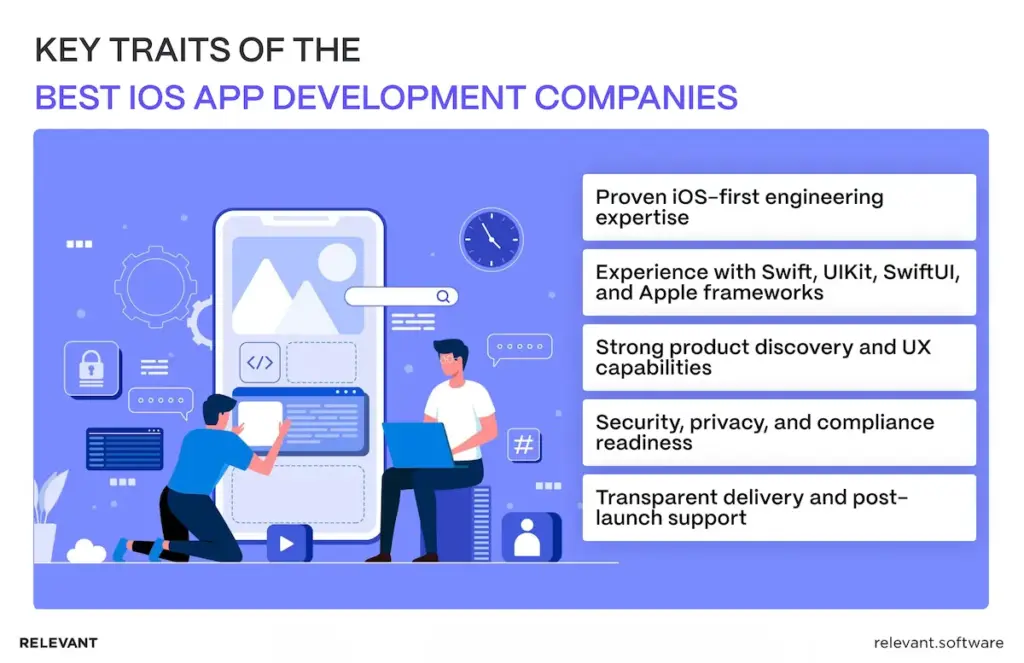
Proven iOS-first engineering expertise
An iOS-first team plans around Apple’s release cycle. It treats OS updates, framework changes, and device behavior as normal work, then bakes that into estimation and testing.
What to validate in calls and technical screens of iPhone applications development companies:
- Ask for a quick walkthrough of how a real app is organized. The structure should be modular, easy to maintain, and not dependent on a single bloated file that controls everything.
- A performance baseline that the team tracks, such as cold start, time to first usable screen, and scroll performance on older devices.
- A device test plan that names target models and iOS versions, plus clear ownership for failures and fixes.
- Evidence of ongoing releases, such as a change log, release notes, or a post-launch improvement plan.
If your evaluation also includes cross-platform and Android scope, align the split early, so iOS work stays clean: Android app development can help frame the parallel track.
Experience with Swift, UIKit, SwiftUI, and Apple frameworks
Swift proficiency helps, but platform judgment matters more. Teams that deliver reliably can justify the UI stack choice, keep it consistent, and avoid frequent rewrites when the product grows.
Ask for concrete examples across:
- How the team decides between UIKit and SwiftUI, when they combine them, and how they keep the codebase coherent.
- Concurrency approach that fits your app type, especially for data-heavy screens and background work.
- Apple frameworks relevant to your scope, such as Push Notifications, Sign in with Apple, MapKit, CoreBluetooth, HealthKit, Wallet, or ARKit.
- Clear boundaries between iOS, backend APIs, analytics, and feature flags, with ownership for each layer.
If stakeholders want help with the native versus cross-platform decision, share this early: Swift vs React Native.
Strong product discovery and UX capabilities
A polished iPhone app comes from good decisions before the first sprint starts. A reliable partner translates business goals into flows, edge cases, and UI behavior that matches Apple conventions, then turns that into a build plan.
A practical discovery phase should produce:
- User flows that include error paths, offline states, and permission prompts, not only the main path.
- Prototypes that show interaction details, such as empty states, loading behavior, and keyboard handling.
- Non-functional requirements written in plain terms: performance targets, accessibility needs, telemetry, and support expectations.
- A release plan that reflects App Store review timing and stakeholder approvals.
Use this as a shared UX reference during discovery workshops: mobile app design guide. If the mobile initiative is part of a broader transformation program, this context also helps align expectations between business and delivery: how mobile apps support digital transformation.
Security, privacy, and compliance readiness
On the best iOS app development services, privacy and security live inside product decisions: what data enters the app, what stays on-device, what moves over the network, and how the system proves control. This matters most in fintech, healthcare, insurance, and any product tied to identity or payments.
Look for a vendor that can explain:
- Secure storage choices for tokens and sensitive data, plus key management practices.
- Mobile risk prevention in API usage and secret handling.
- Privacy-first analytics and retention rules that match your environment.
- Compliance routines that support audit evidence, logging standards, and access control mapping.
Transparent delivery and post-launch support
A reliable partner runs a clear release routine and documents decisions so stakeholders can trust the plan. Post-launch support also stays essential because iOS updates, SDK changes, and production feedback continue after launch.
Signals of a healthy delivery model:
- Sprint updates that include decisions, risks, and next steps in writing, not only meetings.
- Acceptance criteria that define “done” beyond UI completion, including tests and release readiness.
- Release management that uses TestFlight, staged rollout patterns, and a rollback plan.
- A production support approach that covers crash triage, performance monitoring, and hotfix rules.
- A post-launch improvement loop tied to metrics that matter for your app, such as crash-free sessions, conversion, and retention.
If your organization already works in sprints, align roles and cadence up front with a shared reference: the agile methodology.
Top iOS app development companies (2026 edition)
This shortlist highlights providers that consistently appear in mobile vendor evaluations and demonstrate reliable delivery through client reviews, published case studies, and clear service focus. It includes teams that fit startups, mid-market product companies, and enterprise organizations that require predictable execution and delivery confidence.
Relevant Software
Relevant Software is one of the best outsourcing firms where teams can hire iOS developers for long-lived iPhone products. Founded in 2013, the company operates in Eastern Europe, runs a multi-location delivery setup, and supports international product teams.
- Core iOS app development services: Swift app development services, product discovery and UX/UI, QA and automated testing, CI/CD and release management, App Store publishing support, post-launch maintenance, cross-platform delivery when needed, and integrations with backend systems and third-party services.
- Key industries served: Fintech, healthcare, insurance, logistics, retail, and other data-heavy products where security and reliability matter.
- What makes the company stand out: Senior engineers set the architecture early, so the app scales without rework. QA acts as a release gate, so each version stays stable in production. Delivery follows a multi-release roadmap with clear ownership across iterations, which the company cites as a driver of 98% client retention.
- Best fit for which types of clients: Teams that want a smaller, senior-heavy iOS partner for apps that must remain stable over the years, especially when the roadmap includes frequent releases, complex integrations, and strict quality expectations.
Andersen
Founded in 2007, Andersen runs deliveries from Warszawa and other global hubs. It typically fits organizations that need a larger bench across iOS, QA, backend, and design, with staffing flexibility as a priority, as priorities shift.
- Core iOS services: Native iOS development for consumer and enterprise apps, multi-device QA and testing, UX/UI with sprint-based delivery, and integrations with enterprise backends and internal systems.
- Key industries served: financial services, logistics, and healthcare.
- What makes the company stand out: Andersen can quickly assemble mixed teams, keep work structured across several workstreams, and support programs where coordination and predictable delivery matter as much as pure Swift skills.
- Best fit for which types of clients: Enterprise and late-stage product teams that need broad staffing options, multi-region coverage, and a delivery model that holds up across long roadmaps and many stakeholders.
Empat
Founded in 2013, Empat operates from San Francisco with a distributed delivery team. It fits teams that shortlist top iPhone app development companies and want a partner that treats the roadmap as the product, not as a list of “quick wins” that age badly.
- Core services: Native iOS development in Swift, product discovery, UX design, roadmap definition, QA and release support, plus cross-platform delivery when needed (React Native, Flutter).
- Key industries served: SaaS products, marketplaces, ecommerce, fintech, healthcare, and consumer mobile apps.
- What makes the company stand out: A structured discovery-to-support delivery model that connects early product decisions with build, release, and post-launch updates.
- Best fit for which types of clients: Product teams that want a polished iOS app, then a steady cadence of improvements tied to real user behavior.
AppMakersUSA
AppMakersUSA is one of the iOS app development companies in USA that fits teams that want close collaboration on US hours and a vendor that can cover design and delivery under one contract. Founded in 2014, the company often suits stakeholder-heavy projects where clear communication and one accountable partner matter.
- Core iOS app development services: iOS app delivery and modernization, UX/UI and prototyping support, release management, and maintenance.
- Key industries served: Consumer apps and internal business tools across multiple sectors.
- What makes the company stand out: AppMakersUSA tends to work well in stakeholder-heavy setups where alignment matters as much as delivery.
- Best fit for which types of clients: US-based teams that want day-to-day collaboration in their working hours and prefer one partner to cover discovery, UX/UI, iOS delivery, and ongoing releases under a single engagement.
Atta Systems
Atta Systems is one of the best iPhone app development companies, based in Bucharest and also with a presence in Singapore. Founded in 2015, the company fits teams that want a structured sprint routine and predictable delivery for iOS projects.
- Core iOS developments: Native iOS development, UX/UI design, QA and testing, plus backend and API integration for mobile products.
- Key industries served: Healthcare and digital health, education and public-sector platforms, fintech, and data-driven products.
- What makes the company stand out: Atta Systems tends to keep delivery practical and visible. Expect defined sprint goals, regular demos, and written updates to help maintain quality across releases.
- Best fit for which types of clients: Organizations that value predictable timelines, structured collaboration, and an iOS partner that stays reliable across multiple releases in regulated or stakeholder-heavy environments.
EB Pearls
Founded in 2004 and based in Surry Hills, Australia, EB Pearls is an APAC-based product studio that combines design and iOS delivery. It often suits teams that want a single partner to cover UX, iPhone development, backend coordination, and QA within a single delivery model.
- Core iOS services: End-to-end iOS delivery, product design and UX support, ongoing support for post-launch iteration.
- Key industries served: Healthcare, fintech and financial services, ecommerce and retail, real estate and proptech, logistics and on-demand services, and consumer mobile products.
- What makes the company stand out: Strong project management and clear communication, with a delivery rhythm that stays on schedule when many stakeholders need updates and approvals.
- Best fit for which types of clients: APAC (Asia-Pacific) companies or global product teams that want one partner to handle discovery, design, and iOS delivery without splitting work across multiple vendors.
Suffescom Solutions Inc
Founded in 2013, Suffescom Solutions Inc. is often considered when teams need a fast path from prototype to App Store launch and want a single vendor to cover iOS and supporting roles. This mobile technologies company fits clients who prefer a broad service scope across design, development, QA, and integrations.
- Core iOS app development: iOS delivery plus cross-platform options, backend integration for typical marketplace and on-demand patterns, maintenance and support packages.
- Key industries served: Ecommerce and retail, on-demand services, marketplaces, logistics, and consumer mobile products.
- What makes the company stand out: Suffescom can staff iOS, backend, and QA from day one, which speeds up the first release for apps that require payments, push notifications, and admin operations.
- Best fit for which types of clients: Teams that want fast MVP delivery, then plan to invest in hardening, observability, and scalability once usage proves out.
Droids On Roids
Founded in 2011 in Wrocław, Poland, Droids On Roids builds iPhone apps for teams that need experienced iOS engineers and a predictable release cycle across multiple versions.
- Core iOS services: Native iOS delivery in Swift, QA and testing strategy, CI/CD and release management, plus DevOps support for production reliability.
- Key industries served: SaaS and subscription apps, marketplaces, logistics and mobility products, and consumer applications.
- What makes the company stand out: The team runs a disciplined delivery process that keeps iOS releases stable over time, with strong testing and production readiness built into each sprint.
- Best fit for which types of clients: Product teams that need predictable delivery for long-lived iPhone apps, with reliable QA and a partner that supports multi-release roadmaps.
Ackee
Founded in 2012, Ackee is headquartered in Karlín (Czech Republic) and also has a location in Raleigh, North Carolina. The studio builds native iPhone apps for teams that need polished UI work and a dependable release routine across a long roadmap.
- Core iOS development: Swift development (UIKit and SwiftUI), backend and API integration, QA with defined test coverage across key user flows, TestFlight rollout support, and App Store publishing.
- Key industries served: Public-sector platforms and enterprise mobile products.
- What makes the company stand out: A product-focused approach that fits teams who compare top iOS app development firms based on design quality and delivery structure.
- Best fit for which types of clients: Teams that want an iOS-first partner for a long-term roadmap, especially when the app needs a solid UX layer, reliable QA gates, and predictable releases across versions and devices.
JPLoft
JPLoft appears on lists when teams want a full-service vendor that can cover iOS and adjacent needs, such as cross-platform work and optional AI features.
- Core iOS app services: iOS development in Swift, QA, release support, and lifecycle maintenance; cross-platform options (Flutter, React Native); and AI integration that supports the product.
- Key industries served: Fintech, healthcare, education, SaaS, and marketplace-style apps.
- What makes the company stand out: High review volume with consistently strong scores can indicate reliable delivery: communication, schedule adherence, and quality control.
- Best fit for which types of clients: Teams that want one partner for iOS delivery plus supporting product scope, with a clear path to scale features over time.
For readers who want a broader market lens beyond iOS-only vendors, this roundup provides context on the top mobile app development companies.
How to choose iOS development companies for your business
Choosing among the top iOS developers can feel simple on paper, but reality sets in: App Store reviews, edge cases that appear only on real devices, and user expectations that punish even small mistakes. The checklist below helps you evaluate iPhone app development companies with proof, so your final product supports business needs, objectives, and growth rather than delivering a polished demo that falls apart after launch.
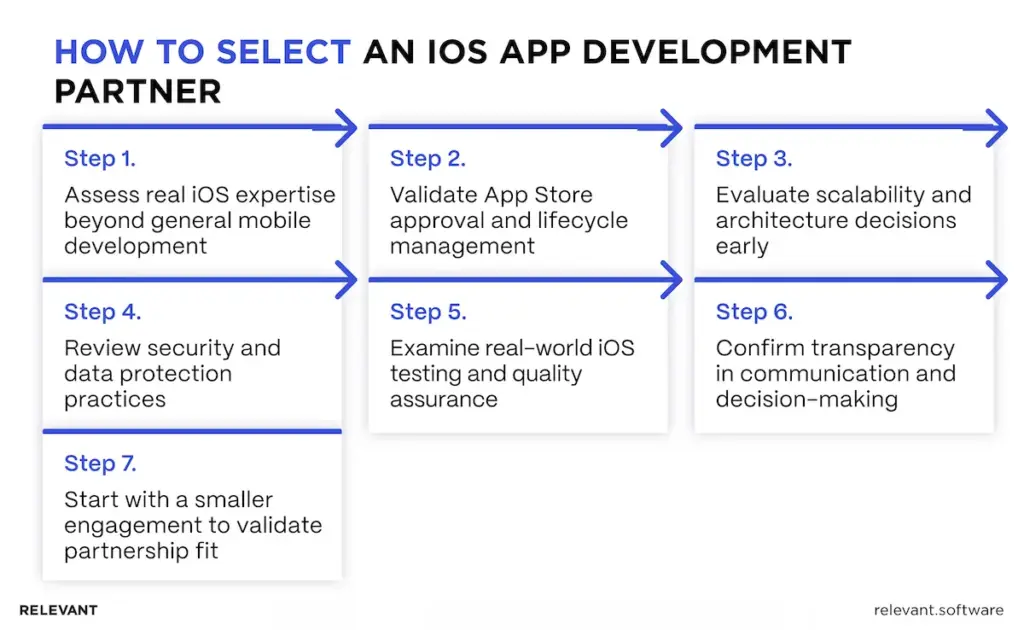
1) Assess real iOS expertise beyond general mobile development
Many teams ship mobile applications. Fewer teams build iOS applications that stay stable across iOS devices and the wider family of Apple devices. Ask the top iPhone app developers to walk through a real app development process from an app idea to release, then verify technical expertise in code, testing, and release work.
What to ask for:
- A short architecture walkthrough and how the development team keeps complexity under control.
- How the team applies best practices across Swift and other programming languages used in the stack.
- Case studies that match your target audience and product model, across various industries.
2) Validate App Store approval and lifecycle management
A successful iOS app rarely depends on one launch day. It depends on repeatable release work: TestFlight builds, App Store metadata, privacy labels, and review readiness. Ask how the vendor handles Apple’s guidelines, including Apple’s Human Interface Guidelines, plus the practical details that keep approvals and updates moving.
What to confirm:
- Ownership for Apple App Store submission, screenshots, keywords, and privacy labels.
- Experience with device-specific features such as Face ID, background tasks, and permissions.
- Support for add-ons such as Apple Watch and Apple TV when the roadmap includes them.
3) Evaluate scalability and architecture decisions early
Scalability usually shows up as slow delivery and fragile changes, not as a single catastrophic event. Strong iPhone application development companies explain how they keep the codebase maintainable as new features arrive, especially when the app connects to APIs, web development work, or a companion web app development scope.
What to review:
- Data-heavy screens, caching, offline flows, and API versioning.
- Integration patterns for payment gateways, analytics, and feature flags.
- Use of artificial intelligence and AI integration when the product needs personalization or automation.
4) Review security and data protection practices
Security decisions belong in the first plan, not in the final week. Ask how the team protects tokens, accounts, and sensitive data, especially in regulated products where compliance and audit evidence matter.
What “good” looks like:
- Clear approach to secure storage, session handling, and secret management.
- Threat scenarios tied to your business needs, not generic checklists.
- Privacy-first analytics aligned with user expectations and data retention rules.
5) Examine real-world iOS testing and quality assurance
Simulators help, yet real users bring real network conditions, old devices, and creative tapping patterns. A strong partner treats QA as part of software development, not as a separate phase that starts late.
What to validate:
- Real device coverage aligned with your user base and OS adoption.
- Automated tests around critical flows and high-risk screens.
- A plan for bug fixes, crash triage, and performance checks after release.
6) Confirm transparency in communication and decision-making
Projects stay healthy when decisions stay visible. Look for written updates, clear owners, and predictable routines that keep stakeholders aligned, including teams that care about social media launches, marketing timing, and internal approvals.
What to expect:
- Weekly written status with decisions, risks, and next steps.
- Clear acceptance criteria and a consistent “definition of done.”
- Regular updates that show progress through demos and working builds.
7) Start with a smaller engagement to validate partnership fit
A short pilot reveals the true delivery rhythm: how the team scopes, builds, tests, and responds when something needs attention. It also helps identify the right iOS app development company before the roadmap expands.
A solid pilot includes:
- A small feature slice that touches user interfaces and API integration.
- A TestFlight build with basic telemetry and user feedback hooks.
- A lightweight plan for version 1.0 plus ongoing maintenance coverage.
A pilot often makes the decision obvious. The top iOS app development company leaves behind clear technical choices, a working release routine, and a codebase that supports regular updates without turning every change into a negotiation.
Final thoughts
Choosing among the iOS apps development companies becomes much easier once you focus on what happens after the first release. Portfolios can look similar, yet day-to-day work separates a vendor from a real partner: how the team plans iOS updates, maintains quality, and turns feedback into better releases without slowing the roadmap.
Use the shortlist as a starting point, then trust proof over promises. Ask for examples of apps they’ve shipped, review how the team handles TestFlight and App Store updates, and confirm what “done” means in writing, not just in meetings.
If you still feel unsure, start small: a short discovery or pilot via custom iOS app development services can show how the team communicates, makes tradeoffs, and ships under real constraints before you scale the engagement.