
Top Software Consulting Companies in 2026
 Vadim StrukProduct Manager and Head of Business Analysis at Relevant Software
Technology leaders face more priorities than ever and less room for delays or overspending. Modernization, AI, cloud migration, and security all compete for the same attention, while existing systems still keep core operations running. Recent Gartner data show that for most organizations, more than 70% of the IT budget still goes toward maintaining current operations, leaving less than 30% for real change and innovation. Because of this pressure, many enterprises turn to software consulting companies rather than relying solely on in-house teams.
The best partners combine business consulting, software engineering, and delivery leadership in a single team. They translate strategy into roadmaps, design realistic architectures, and guide execution until the new platform, integration layer, or product actually runs in production.
This guide walks through key criteria for choosing a partner, then profiles ten top software development consulting companies that help enterprises modernize core systems, scale cloud and AI initiatives, and keep delivery predictable. Taken together, these examples show how software development consulting services connect strategy, architecture, and day-to-day delivery in real projects.
Comparison table: top software consulting companies at a glance
When technology leaders start comparing partners, they rarely want a random software consulting companies list. They want a feel for how each firm works, what it is really good at, and where it might not be the right choice. The companies below cover global giants, and one focused mid-size partner, so you can see how different models fit different roadmaps.
Before you dive into individual profiles, it helps to see how the leading players compare side by side. The table below summarizes core services, primary locations, and a few notable clients where public data is available.
| Company | Core services | Main locations / corporate headquarters | Notable clients |
| Relevant Software | Software development consulting, AI consulting, custom development, cloud, and data services | Lviv HQ with EU presence | AstraZeneca, Volkswagen, Norwegian |
| Accenture | Digital transformation, cloud, AI, custom development, managed services | Dublin HQ, offices in 120+ countries | Unilever, Microsoft |
| Deloitte | Strategy, risk, digital, enterprise software implementation, analytics | London HQ for Deloitte North South Europe, global offices | Yamaha, Adobe, World Bank Group / IFC |
| IBM Consulting | Hybrid cloud, AI, app modernization, data platforms | Armonk HQ, global delivery centers | Maersk, American Airlines |
| Capgemini | Application services, cloud, data, AI, business consulting | Paris HQ, global presence in 50+ countries | Coca-Cola, T-Mobile, United Airlines via WNS |
| Cognizant | Digital engineering, cloud, data, enterprise optimization | Teaneck HQ, strong in the US and Europe | Aston Martin Aramco Cognizant Formula One Team (AMF1), Nordea Bank |
| Infosys Consulting | IT strategy, application development, cloud, and AI platforms | Bengaluru HQ, delivery hubs worldwide | Vanguard, BP |
| Thoughtworks | Product consulting, agile delivery, cloud, and data platforms | Chicago HQ, global offices | Spotify, Mercedes-Benz |
| Slalom | Strategy, cloud modernization, data, digital products | Seattle HQ, consulting hubs across North America, Europe, Asia-Pacific | Starbucks, Alaska Airlines |
| PwC Technology Consulting | Digital strategy, cloud transformation, cybersecurity, enterprise systems | London HQ for PwC UK; global network across 150+ countries | Salesforce |
Key criteria to choose the top software consulting companies
The right software consulting partner changes how fast you move, how much risk you carry, and how much value you get from every euro or dollar you spend through software consulting services. The points below help you look past marketing slides and judge firms on what actually matters in delivery with clear business objectives.
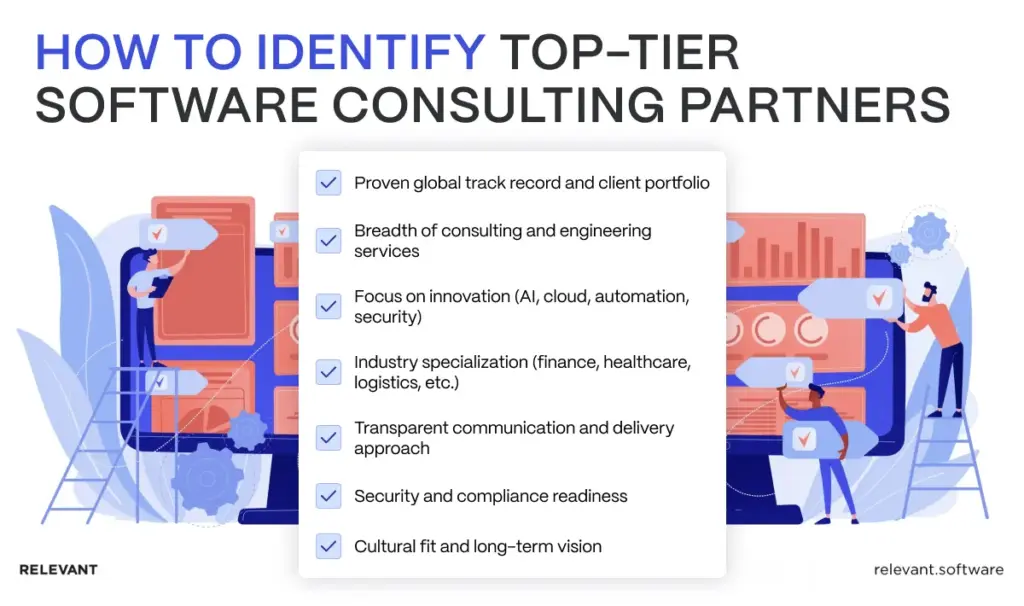
Proven global track record and client portfolio
Start with proof. Strong partners can show:
- projects of similar size and complexity that required software development consultation
- clients in more than one region, often in high-tech environments
- outcomes expressed in numbers, with measurable impact on sustainable growth
Look for case studies with concrete results, named clients where possible, and relationships that last for years, not months. A consistent record across different environments signals that the company can handle real-world constraints, not only ideal conditions and market changes.
Breadth of consulting and engineering services
Most initiatives shift shape over time. You might begin with a strategy, then need architecture, data work, security input, and ongoing support. Good software consulting companies cover this whole arc and offer a broad range of services:
- product and technology strategy with a straightforward strategic approach
- solution architecture and design that considers custom software development
- hands-on engineering and integration across web systems and mobile apps
- support, optimisation, and further evolution of core IT services
When these capabilities live under one roof, you spend less time managing handovers and more time making progress in the software development process instead of reacting with quick fixes.
Focus on innovation (AI, cloud, automation, security)
Modern systems rely on AI, cloud computing, and automation, but not every problem requires advanced tooling. A capable partner:
- understands AI, generative AI, predictive analytics, and cloud-native patterns in depth
- can explain when these tools genuinely help and where innovative solutions add value
- avoids adding technology that only increases cost and complexity, including hidden infrastructure costs
Look for firms that back their recommendations with clear reasoning and examples on platforms such as Google Cloud and Amazon Web Services.
Industry specialization (finance, healthcare, logistics, etc.)
Domain knowledge saves time and reduces mistakes. Regulations, data models, and user workflows vary across sectors. A serious partner in your space:
- knows typical system landscapes and how business processes behave in practice
- understands regulatory constraints and exposure to cyber threats
- has reusable patterns for your type of product or process that respond to market trends
This context helps them ask better questions and design solutions that align with how your business actually operates in high-tech industries and beyond.
Transparent communication and delivery approach
Projects rarely fail because of code alone. They fail because people do not share the same picture of scope, risks, or progress. Look for partners who:
- explain trade-offs in simple language and follow best practices in project management
- share realistic timelines, budgets, and a clear hourly rate structure
- maintain a clear status, not only “green” dashboards, and respond to issues in customer service
Transparency is a good proxy for overall maturity. If conversations feel transparent and honest early on, delivery usually follows the same pattern and supports a lasting competitive advantage.
Security and compliance readiness
Security and compliance influence architecture, data flows, and daily operations. A strong consulting firm:
- designs with security controls from the first diagrams to protect sensitive data
- understands relevant standards and regulations for software development services
- can work with your legal, risk, and security teams as peers when assessing cyber threats
This avoids last-minute redesigns, failed audits, and unplanned costs when you are close to launch and trying to preserve operational efficiency.
Cultural fit and long-term vision
Finally, you will work with this company for months or years. Cultural fit is not a soft factor. It affects speed and trust every week. Look for:
- similar expectations around quality and ownership at a digital services company level
- openness to feedback on both sides and attention to the client’s unique objectives
- interest in your roadmap beyond the current project and commitment to sustainable growth
The best software consulting companies act like long-term partners, not short-term vendors. They help you build systems and teams that will still make sense three to five years from now, not only at go-live, and give your organisation a clear competitive advantage.
Top software consulting companies in 2026: detailed profiles
This part of the guide looks at the 10 top software consulting companies that keep appearing in analyst reports, case studies, and RFP shortlists. It is not a rigid ranking, more a curated software consulting companies list that shows different shapes of partners, from global brands to focused specialists.
Together, they illustrate how top IT consulting companies approach digital strategy, enterprise software, cloud computing, and artificial intelligence, and where each one usually fits best.
1. Relevant Software
Relevant Software operates as a focused software consulting and development partner for companies that value predictable delivery as much as new features. Instead of large hierarchical teams, it provides a team of senior specialists who stay close to the people owning the product, budget, and outcomes. The same group shapes the roadmap, designs the architecture, and remains accountable for getting the release into production, which many clients find more efficient than the traditional split between separate consulting and development units.
This model reduces handoffs, eliminates strategy-to-execution gaps, and gives clients direct access to the engineers who make key decisions. For organisations modernising critical systems or introducing AI-driven capabilities, this tight collaboration often leads to faster iterations, better technical choices, and far fewer surprises during delivery.
- HQ location: Lviv, Ukraine, with offices in Poland and Spain.
- Years on the market: 10+ years, more than 200 commercial projects.
- Areas of expertise: Software development consulting, AI and data engineering, cloud solutions, product consulting, and custom web and mobile applications.
- Key industries: Fintech, healthcare, pharma, logistics, SaaS, and edtech.
- Why it stands out: High share of senior talent, 98% of client satisfaction, and a habit of starting from business goals rather than a fixed tech stack. The company also invests in internal AI capabilities and delivery tooling, including an AI-powered estimation platform that speeds up early planning and reduces project risk. Among mid-size software consulting firms, it feels more like an in-house team than a vendor.
- Good fit when: You need a nearshore software consulting company that can participate directly in planning sessions, share delivery risk, and work seamlessly with your engineers, analysts, and product owners. This is especially relevant when modernising legacy systems, building AI-enabled products, or aligning architecture with business strategy.
2. Accenture
Accenture is often the first name that appears when leaders search for top software development consulting firms. It is built to handle extensive, multi-year programmes that cut across business units, countries, and technology stacks. A typical engagement may touch hundreds of systems, involve several cloud providers, and still operate under a single steering structure. This scale is difficult for smaller software consultancy companies to match.
- HQ location: Dublin, Ireland.
- Years on the market: Around 30 years under the Accenture brand.
- Areas of expertise: Digital strategy, enterprise transformation, cloud migration, analytics, artificial intelligence, managed services.
- Key industries: Financial services, consumer and retail, public sector, health and life sciences, manufacturing, and energy.
- Why it stands out: Combines business consulting, industry knowledge, and large engineering capacity in one organisation. It is one of the top software development consulting companies for global enterprises that want a single prime partner.
- Good fit when: You run a complex international organisation and need one of the best software consulting companies to coordinate many workstreams, suppliers, and internal teams over several years.
3. Deloitte
Deloitte combines technology, risk, and business consulting in one network. Many regulated organisations choose them when digital change and compliance move in step, and board members expect clear answers on both.
- Years on the market: 100+ years of professional services, decades in IT and software consulting.
- Areas of expertise: Enterprise software implementation, cloud adoption, cybersecurity, analytics, software development consultants and architects, governance, and compliance.
- Key industries: Banking, capital markets, insurance, energy, consumer products, public sector, healthcare, and life sciences.
- Why it stands out: Its strong ability to link strategy, regulation, and execution keeps Deloitte near the top of any list of the top software consulting companies in heavily regulated fields.
- Good fit when: You need one team that can speak with regulators, boards, and engineers and maintain a shared roadmap for all three groups.
4. IBM Consulting
IBM Consulting focuses on hybrid cloud, AI, and application modernization, backed by IBM’s technology portfolio and long history with enterprise software. Many clients rely on IBM to move critical workloads from mainframes or legacy stacks into more flexible cloud environments while maintaining strict service levels and security requirements.
- Years on the market: 30+ years of consulting activity inside IBM.
- Areas of expertise: Hybrid cloud architecture, data and AI platforms, application modernisation, integration with enterprise software, security, and managed services.
- Key industries: Banking and financial services, telecom, manufacturing, public sector, transport, and logistics.
- Why it stands out: Deep knowledge of legacy technology and strong AI practice make IBM one of the safest IT software consulting companies for high-risk change in core systems.
- Good fit when: Your most critical applications still run on older platforms, and you need a partner who understands how to reduce risk at every phase of your cloud journey.
5. Capgemini
Capgemini is a European heavyweight among software consulting companies, with strong engineering and consulting presence across the continent and beyond. It often works with organisations that run complex back-office processes in many markets and are now moving toward cloud-first operations and better customer journeys. Capgemini brings structured programmes rather than one-off projects, which many enterprises view as a safer path.
- HQ location: Paris, France.
- Years on the market: More than fifty years in technology and business consulting.
- Areas of expertise: Digital engineering, cloud migration, customer experience platforms, data and AI, business consulting, and large agile delivery programmes.
- Key industries: Financial services, manufacturing, automotive, consumer products, utilities, and public sector.
- Why it stands out: Good balance between process discipline and engineering depth, plus strong roots in Europe, it often appears in shortlists of top software development consulting companies for multi-country programmes.
- Good fit when: You have operations across several European markets and want a structured partner that understands local realities but can still run a single cross-border transformation.
6. Cognizant
Cognizant sits in the space between classic consulting and outsourcing. It helps clients modernise systems, adopt cloud and data platforms, and then often stays to operate those systems. For technology leaders, this reduces the number of vendors and handovers. It also means the same organisation that designed a solution keeps responsibility once it goes live, which many CIOs see as a healthy form of pressure.
- HQ location: Teaneck, New Jersey, United States.
- Years on the market: Around 30 years in technology and business services.
- Areas of expertise: Application development and modernisation, cloud services, data and analytics, digital operations, automation, and industry platforms.
- Key industries: Healthcare, insurance, financial services, life sciences, retail, and consumer brands.
- Why it stands out: Strong domain knowledge in regulated sectors and a global delivery network that can support long-running projects. Within software consulting firms, it is often chosen for combined “build and run” arrangements.
- Good fit when: You want one partner to modernise large estates and also take over a significant portion of day-to-day operations under clear service level agreements.
7. Thoughtworks
This company built its name on engineering quality and modern ways of working. Many internal leaders read Thoughtworks articles long before they work with the company itself. On projects, its consultants usually sit next to in-house teams, help them design cloud-native systems, and introduce practices such as continuous delivery and trunk-based development. This shape sets it apart from more traditional software engineering consulting companies.
- HQ location: Chicago, Illinois, United States.
- Years on the market: More than 30 years in custom software and consulting.
- Areas of expertise: Product consulting, agile and DevOps transformation, cloud-native architecture, data platforms, and continuous delivery pipelines.
- Key industries: Automotive, financial services, retail, media, digital-native, and high-growth technology companies.
- Why it stands out: Engineering culture first, slideware second. Thoughtworks usually leaves behind stronger teams, not only finished systems. It is a reference point among software engineering consultants who care about long-term maintainability.
- Good fit when: You want to raise the bar for your own developers and delivery managers while you modernise architecture or launch new digital products.
8. Infosys Consulting
Infosys Consulting connects high-level strategy work with large delivery centres, which many global enterprises value. The consulting team defines target operating models, data strategies, and application landscapes. The broader Infosys organisation then supplies the engineers who build and support those systems. This end-to-end setup is a key reason Infosys is often included among the top software consulting companies.
- HQ location: London, United Kingdom, connected with Infosys headquarters in Bengaluru, India.
- Years on the market: Around 20 years with Infosys Consulting, supported by more than 40years of Infosys history.
- Areas of expertise: IT strategy, cloud migration, analytics, enterprise modernisation, ERP and platform programmes, business consulting.
- Key industries: Financial services, manufacturing, telecom, consumer and retail, energy, and utilities.
- Why it stands out: Brings together strategic advice and large-scale implementation capacity under one brand. In the landscape of software development and consulting companies, this reduces the risk that strategy and implementation drift apart.
- Good fit when: You want a long-term partner that can design multi-year roadmaps and then assign enough people to execute them across several regions.
9. Slalom
Slalom started as a local consultancy and grew into an international firm, but it kept a practical, people-first style. Many clients know Slalom for its cloud and data work, delivered by teams that sit close to the client’s offices rather than far away. That shape makes communication easier and often speeds up decisions, especially in the early stages of programmes.
- HQ location: Seattle, Washington, United States.
- Years on the market: More than 20 years in consulting.
- Areas of expertise: Cloud architecture, data and analytics, product engineering, customer and employee experience, security, and close partnerships with major cloud providers.
- Key industries: Airlines and travel, insurance, retail, technology, and financial services.
- Why it stands out: Combines strong cloud skills with a collaborative way of working that feels close to an internal team. Among software consultancy companies, it is often seen as the “hands-on” option.
- Good fit when: You want to move quickly with cloud and data projects and prefer consultants who co-create solutions with your team on-site or nearshore.
10. PwC Technology Consulting
PwC Technology Consulting sits within a broader network known for audit, tax, and risk work. That background shapes how it approaches technology. On most programmes, the firm pays close attention to data governance, controls, and reporting obligations from day one, rather than treating them as a final check. This approach makes it a frequent choice in sectors where regulators and boards watch every major technology decision.
- HQ location: London, United Kingdom.
- Years on the market: More than 25years under the PwC brand, with a longer heritage from predecessor firms.
- Areas of expertise: Technology and digital strategy, cloud and data platforms, cybersecurity, AI adoption, governance, and compliance.
- Key industries: Banking and capital markets, broader financial services, healthcare and pharmaceuticals, energy and utilities, public sector, and telecom.
- Why it stands out: Treats transformation and control as one discussion. Within software consulting companies, it is powerful where data, regulation, and public trust are central concerns.
- Good fit when: You must modernise systems, tighten data governance, and keep auditors and regulators comfortable, and you prefer a partner that already understands your reporting and risk language.
Benefits of partnering with a software consulting company
A strong software consulting company starts with business needs and turns them into a clear plan for change. It stands between leadership and delivery, and aligns strategy with software solutions that fit how the organisation actually works. Its work supports business transformations, so technology investments reinforce long-term goals instead of short-lived experiments. The right consulting partner helps leaders choose priorities, sequence work, and stay competitive in a crowded software industry.
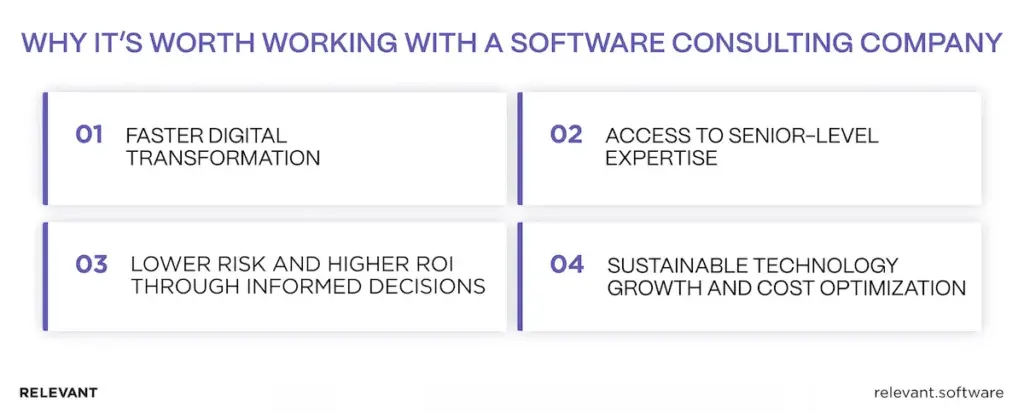
Faster digital transformation
Modern projects often slow down because requirements clash with legacy systems and different teams pull in different directions. An experienced consulting team keeps scope, risks, and timelines steady, making progress easy to track. They design solutions that work with what you have today while creating room for new products and channels.
Structured changes streamline operations and remove friction between teams. When the scope is clear and existing assets are reused, companies save money instead of constantly putting out fires. Over time, this approach leads to scalable systems instead of one-off patches. Most successful engagements blend focused consulting with software development services, ensuring ideas move from slides to genuine, working software.
Access to senior-level expertise
Senior software consultants have seen similar problems across many organisations and markets. Experienced consultants have worked on projects that went well and on projects that didn’t. Both kinds of experience teach them what actually works, what usually goes wrong, and where the real risks hide. This helps them make practical, realistic decisions when designing a solution.
Data science specialists focus on how to better guide products, pricing, and operations with insights. Experts in machine learning choose use cases where data patterns genuinely change decisions, not where algorithms add noise. A well-balanced development team pairs architects with engineers who stay responsible for what runs in production.
Lower risk and higher ROI through informed decisions
Thoughtful advisers start by examining how planned systems protect sensitive data throughout their lifecycle. They test failure scenarios, capacity limits, and integration points before budgets scale up. Precise analysis supports better resource allocation because leaders see which risks matter most. Investments then focus on initiatives that deliver measurable results rather than cosmetic change.
Sustainable technology growth and cost optimization
Structured architectures reduce duplication, simplify support, and increase overall operational efficiency. Consultants guide process automation carefully, so teams keep control of decisions that still need human judgment. The outcome is a portfolio of systems that remain adaptable as products, markets, and regulations evolve.
Final words
Software consulting firms operate where business goals meet technical limits. A strong partner turns strategy into a clear, prioritized roadmap, chooses architectures that fit your reality, and stays accountable until your systems and teams improve.
If your organization is evaluating options now, use this guide as a starting point rather than a final shortlist. Validate every claim with references, ask direct questions during discovery, and compare at least one global player with at least one focused software consultancy company that feels closer to your internal culture.