
Best React.js Development Companies: 2026 Comparison
 Vadim StrukProduct Manager and Head of Business Analysis at Relevant Software
React remains a practical choice for scalable web products because the talent pool remains deep and active. In Stack Overflow’s 2025 Developer Survey, 44.7% of respondents reported using React as a web framework or technology in the past year. The popularity of React.js development services is an advantage, but it also sets higher expectations. Many teams can build components. Far fewer can maintain clean architecture, strong performance, and stable releases once real users and tight deadlines enter the picture.
This guide helps CTOs, engineering leaders, and procurement teams compare the best React js development companies through a simple, delivery-first lens. You will find a comparison table and a 2026 shortlist with clear notes on strengths and engagement models.
Comparison table: top React development companies
This table gives a fast baseline before you read the deeper company notes from the best React JS development companies. Pricing ranges reflect Clutch-listed average hourly rates and minimum project sizes, which can shift based on scope, team seniority, and engagement model.
| Company | Core React services | Locations | Clutch client reviews | Pricing range | Notable public references |
| Relevant Software | React web apps, product engineering, custom software development, UX/UI, QA, SaaS platforms. | Lviv (UA) Warsaw (PL)Valencia (SP) | 4.9 (31) | Min $50k; $50–$99/hr | AstraZeneca, Norwegian, Ossur, Volkswagen |
| Saritasa | React web apps, modernization, multi-system builds | Newport Beach, CA (US) | 4.8 (88) | Min $25k; $150–$199/hr | The Cheesecake Factory, Makita USA, University of Kentucky, Kelsey-Seybold Clinic |
| Atta Systems | React products with strong discovery and delivery hygiene | Bucharest (RO) | 5.0 (19) | Min $25k; $50–$99/hr | UNICEF, World Bank, USAID, EY |
| Merixstudio | React delivery at enterprise pace, modernization programs | Poznań (PL) | 4.8 (30) | Min $25k; $50–$99/hr | Expo City Dubai, Volvo, Toshiba, Juilliard |
| Thoughtbot | React + product thinking, UX craft, long-term maintainability | Boston (US) | 4.9 (29) | Min $10k; $150–$199/hr | Merck, Planned Parenthood, MoMA, Harvard Business Review |
| Altar.io | MVP-focused React development, early product validation | Lisbon (PT) | 4.9 (26) | Min $25k; $50–$99/hr | Krepling |
| PopArt Studio | React development services | Chicago, IL (US) | 4.9 (20) | Min $10k; $25–$49/hr | IBM, Nike, Lidl, Schwarzkopf |
| Fooz | React + CMS/headless realities, post-launch support | Katowice (PL) | 5.0 (17) | Min $10k; $50–$99/hr | Smoobu |
| Urban Insight | React for content-heavy, accessible, governed web platforms | Los Angeles, CA (US) | 4.9 (29) | Min $10k; $150–$199/hr | USC, LACMA, The Broad, City of Los Angeles |
| Phenomenon Studio | React products with UX depth, end-to-end delivery | Los Angeles, CA (US) | 5.0 (53) | Min $10k;$50–$99/hr | Keap |
What makes a great React.js development partner?
A strong React js application development company brings more than just React skills. Teams should prove they can keep the front end stable as features multiply, contributors rotate, and product goals shift. The signals below help you separate “can code React” from “can run React in production for years,” which matters when the app stops being a project and starts being a daily business dependency.
When evaluating a React development agency or comparing React JS development agencies, also check whether the vendor can scale delivery without sacrificing quality, which often depends on team size and the vendor’s ability to expand through staff augmentation.
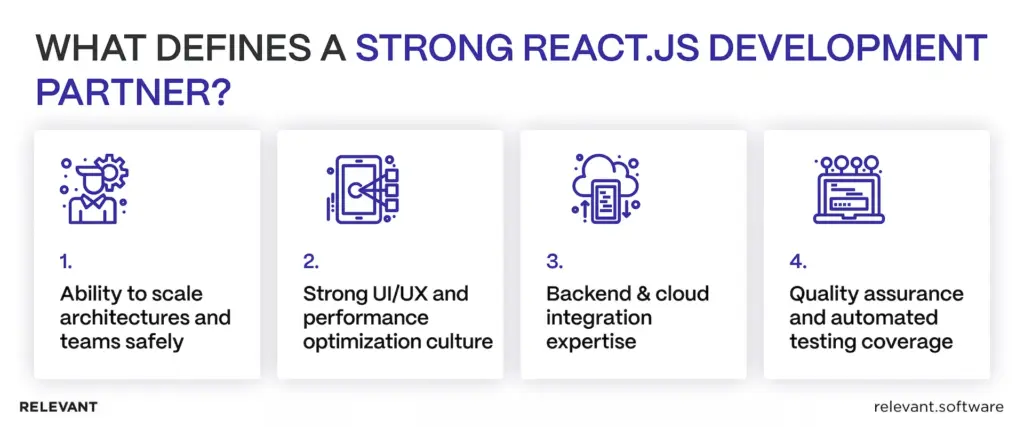
Ability to scale architectures and teams safely
Architecture decisions made in the first weeks decide whether the codebase stays maintainable after the tenth release. Look for a team that can explain structure, boundaries, and upgrade paths in plain terms, then enforce them with process and tooling, not with heroic refactors. When the partner operates as a web development agency across multiple regions, confirm that the engagement model supports stable ownership and clear handoffs.
Key indicators to verify:
- Modular design with clear boundaries: feature-based modules, shared UI library governance, and rules that prevent cross-feature dependency chaos.
- Micro-frontends are used for a reason: a clear adoption trigger, a plan for routing, shared state, versioning, and releases.
- Code ownership and decision records: ownership per area, short architecture notes for major choices, predictable review standard.
- Upgrade discipline: React and dependency upgrades planned as routine work, not as an emergency project that starts with “it should be quick”.
A solid foundation keeps growth boring in the best way, which frees teams to focus on delivery outcomes across app development initiatives.
Strong UI/UX and performance optimization culture
React interfaces succeed or fail based on user experience. A strong partner treats performance and accessibility as core requirements and measures them continuously, instead of expecting users to accept slow or awkward screens. When a product includes both web and mobile apps, they should look and behave the same. That consistency is part of the definition of “done,” especially when teams share a single design system.
What to look for:
- Performance budgets and audits: lighthouse checks, bundle size targets, and clear rules for code splitting and lazy loading.
- Accessibility as a workflow: keyboard navigation, contrast standards, ARIA patterns, and review checkpoints for critical flows.
- Responsive design that stays consistent: design tokens, reusable layout primitives, and predictable behavior across breakpoints.
- Real performance fixes: profiling, memoization where it helps, payload reduction, and fewer “loading spinners as a feature.”
Great UI still depends on stable data contracts and reliable delivery infrastructure, so integration depth matters next, particularly in mobile development programs.
Backend & cloud integration expertise
In many React projects, problems don’t come from the UI itself but from how it connects to the backend. Authentication flows, API behavior, real-time data, and deployment stability are where products often break. A capable team plans the front end with these realities in mind, so the application remains reliable even when services respond with delays, errors, or edge cases. If a vendor operates across multiple regions or promotes onshore delivery hubs, clarify how integration ownership is handled across teams and time zones to avoid gaps in accountability.
Evidence to ask for:
- API integration maturity: REST or GraphQL patterns, versioning strategy, error contracts, and caching rules.
- Node.js and BFF patterns: when a backend-for-frontend helps, how it reduces coupling, and how teams keep it secure.
- Cloud delivery basics: API gateways, serverless endpoints when appropriate, CDN caching, and observability for front-end issues.
- Real-time application know-how: WebSockets or SSE, state reconciliation, and resilience under network instability.
Once data flows are stable, quality practices determine whether releases go smoothly or turn into repeated “hotfix” emergencies, especially when the product shares logic with React Native teams.
Quality assurance and automated testing coverage
A serious React.js development partner builds confidence into the delivery process. Teams should combine unit, integration, and end-to-end tests in a way that protects the highest-risk flows without turning the pipeline into a slow or flaky blocker that breaks at the worst possible time.
What strong coverage looks like:
- Unit and component tests: Jest plus component-level behavior checks for core logic and shared UI.
- Integration testing: API contract validation, realistic mocks, and checks that catch breaking backend changes early.
- End-to-end tests for critical paths: Cypress suites focused on revenue and workflow flows, run in CI with stable test data.
- Release discipline: definition of done includes test updates, regression rules, and a plan to control flaky tests fast.
If you want a cleaner path to the best partner decision, align delivery expectations early. Teams that prefer scope-led delivery often start with custom React js development, while teams that need capacity growth often hire React.js developers.
Top React js development companies (2026 list)
W3Techs reports that React appears on 6.2% of all websites (and 7.7% of sites where a JavaScript library is detected), based on its tracking as of December 15, 2025. That scale makes vendor choice harder than it looks: many teams can build React screens, but fewer can keep a front end fast, stable, and easy to change after months of releases.
This 2026 shortlist highlights top React js development companies with reliable public signals and repeatable React delivery. Use it to narrow the field, then confirm fit with a short technical screen that checks architecture decisions, performance expectations, automated testing, and support terms.
Relevant Software
Relevant Software is a React.js development company with years of experience and a 98% client retention rate, delivering web applications that remain reliable long after launch. The team sets the front-end architecture early, agrees on performance targets, and applies consistent QA and testing standards, so releases remain stable as features expand. This delivery model fits products with long roadmaps, multiple user roles, and integrations that tend to create post-launch surprises.
- Headquarters and presence: Lviv, Ukraine, with offices in Poland and Spain.
- Years in the market: Founded in 2013.
- Key industries: Healthcare, FinTech, Pharma, EdTech, Construction, and Retail.
- Engagement models: Project delivery, dedicated teams, and consulting-style support.
- What stands out: Senior-led teams take full ownership of outsourced React.js development, from planning through release, making accountability clear and delivery predictable.
Saritasa
Saritasa is a React js development company in USA that suits teams that want a US-based footprint and a structured, enterprise-ready process. It often works well when the scope includes integrations, long-term support, and multiple stakeholder groups that expect predictable communication across phases.
- Headquarters & presence: Newport Beach, CA, plus multiple US locations.
- Years in the market: Founded in 2005.
- Key industries served: Media, consumer, industrial, automotive data, and healthcare-adjacent work based on listed clients.
- Engagement models: Project delivery plus long-term support across web, mobile, and modernization workstreams.
- What makes them stand out: Saritasa brings a US-based delivery setup and enterprise project control, which helps when a React build must align with procurement rules, multiple stakeholders, and complex integrations.
Atta Systems
Atta Systems is the best company for React js app development when your team values delivery discipline as much as code quality. The style reduces late-stage surprises by helping teams align early on UI patterns, performance targets, and test scope, and then stick to those rules when the roadmap shifts.
- Headquarters & presence: Bucharest, Romania; delivery shown across international and North American projects.
- Years in the market: Founded in 2015.
- React.js expertise & notable projects: Case studies include an EY platform that automated reporting workflows, plus a long-term partnership with Nicola Wealth.
- Key industries served: FinTech and financial workflows, enterprise platforms, and public-sector style programs.
- Engagement models: End-to-end product delivery with ongoing partnership options.
- What makes them stand out: Atta Systems runs React projects with a tight discovery and precise execution rhythm, so interaction patterns, performance goals, and test scope stay consistent through delivery.
Merixstudio
Merixstudio works well as a React.js application development company with decades of experience and an enterprise-level cadence. It also supports UX and UI design, helping with modernization programs where legacy UI debt slows delivery and increases maintenance costs.
- Headquarters & presence: Poland-based presence with global delivery.
- Years in the market: Founded in 1999.
- Key industries served: Smart-city, travel and entertainment, education, and platform-style products.
- Engagement models: Product development and consulting support for multi-stakeholder programs.
- What makes them stand out: Merixstudio handles large-scale React modernization work with a predictable program cadence, reducing risk when several teams, systems, and timelines operate in parallel.
Thoughtbot
Thoughtbot fits teams that want a React js web development company with strong product thinking and high UX design standards. The company often works best when the roadmap changes often, and the team still needs clean architecture and consistent quality. It is also a good match when internal teams want to learn better delivery practices, not only to receive code.
- Headquarters and presence: US-based presence with distributed delivery.
- Years in the market: Founded in 2003.
- Key industries: Product-led companies, publishing and media, plus broader digital product work across domains, reflected in case studies.
- Engagement models: Consulting-led delivery, discovery, and long-term product iteration.
- What stands out: Thoughtbot applies product thinking and strict engineering standards to React work, which keeps the codebase coherent even when priorities shift and scope expands.
Altar.io
Altar.io suits founders and innovation teams that want MVP development with clear validation. The approach typically focuses on scope discipline and product clarity, so the React architecture supports fast learning without breaking under the first real release cycle. If the project needs strong pushback on feature bloat, this style helps.
- Headquarters and presence: Lisbon, Portugal.
- Years in the market: Founded in 2015.
- Key industries: Startup and product-led environments, with work that often aligns with SaaS and platform-style delivery.
- Engagement models: Product discovery plus delivery teams, often structured as a dedicated product squad.
- What stands out: That React js web development company keeps delivery focused on validated outcomes, which limits feature sprawl and protects timeline control in MVP and early-scale stages.
PopArt Studio
PopArt Studio fits teams that need strong design execution alongside React delivery. It often works well when brand consistency, design systems, and UI responsiveness carry real business weight. This can help avoid late-stage “pixel debates” that consume time and patience, mainly when multiple stakeholders review UI changes.
- Headquarters and presence: Chicago, IL, US.
- Years in the market: Founded in 2010.
- Key industries: Web product builds across “other industries” on Clutch, with a mix of custom web applications and UI programs reflected in reviews.
- Engagement models: Project-based design and development, with UI/UX plus frontend scope standard in reviews.
- What stands out: PopArt Studio keeps design and React implementation tightly aligned, which helps teams ship consistent UI across devices without late rework and style drift.
Fooz
Fooz fits teams where React must coexist with a CMS-heavy setup. Many marketing and content platforms rely on WordPress or headless stacks, and React shows up through custom components, editorial experiences, and performance-focused front ends. This is a practical choice when content teams publish frequently, and the UI still needs to stay fast.
- Headquarters and presence: Katowice, Poland.
- Years in the market: Founded in 2012.
- Key industries served: Web platforms and content-led products, with UX/UI and web development scope.
- Engagement models: Delivery teams that cover web engineering plus UX/UI, often in longer cycles
- What makes them stand out: Fooz builds React front ends that remain reliable in CMS-heavy setups, so frequent content updates do not break layouts, performance, or core journeys.
Urban Insight
Urban Insight suits mission-driven organizations that need modern web applications with strong accessibility and governance. Their portfolio focus often fits museums, universities, associations, and public-sector organizations, where stakeholder alignment and compliance shape delivery. React work tends to sit alongside Next.js and Node.js patterns for modern, maintainable platforms.
- Headquarters and presence: Los Angeles, CA.
- Years in the market: Founded in 2000.
- Key industries: Museums, universities, public institutions, and content-heavy digital experiences.
- Engagement models: Project delivery plus ongoing support for platform evolution and performance maintenance.
- What stands out: Urban Insight supports React platforms where accessibility and governance drive delivery, which fits institutions with strict review cycles and public-facing requirements.
Phenomenon Studio
Phenomenon Studio fits teams that treat UI as a business lever, with a strong focus on UX clarity and end-to-end delivery. This works well for SaaS dashboards, fintech flows, and complex user journeys, where minor UX issues can lead to churn. The firm supports different collaboration models, so teams can run a complete build or extend an internal group.
- Headquarters and presence: Dover, Delaware, with a broadly distributed footprint.
- Years in the market: Founded in 2019.
Key industries: Healthcare, SaaS, FinTech, and EdTech appear across public profiles and project positioning. - Engagement models: Product design plus development, with support from early concept through scale, as described on their projects pages.
- What stands out: Phenomenon Studio delivers UX-led React interfaces that remain clear under real-world data and complex flows, reducing friction in high-stakes user journeys.
If you plan to hire React js development companies in 2026, use this shortlist as a structured starting point, then confirm fit with evidence from real delivery. The best choice depends on what you build and how quickly it must evolve, especially when the React work supports digital transformation and integrates with multiple systems, stakeholders, and release cycles.
Your next read: Top IT outsourcing companies.
How to choose the best React js development company for your project
After you shortlist React.js development companies, move from opinions to proof. The goal is simple: pick a software development company that is a good fit for delivery under real constraints, not only for a demo. This flow works for top companies in enterprise procurement and for lean product teams, because it tests the same things: clarity, execution, and ownership.
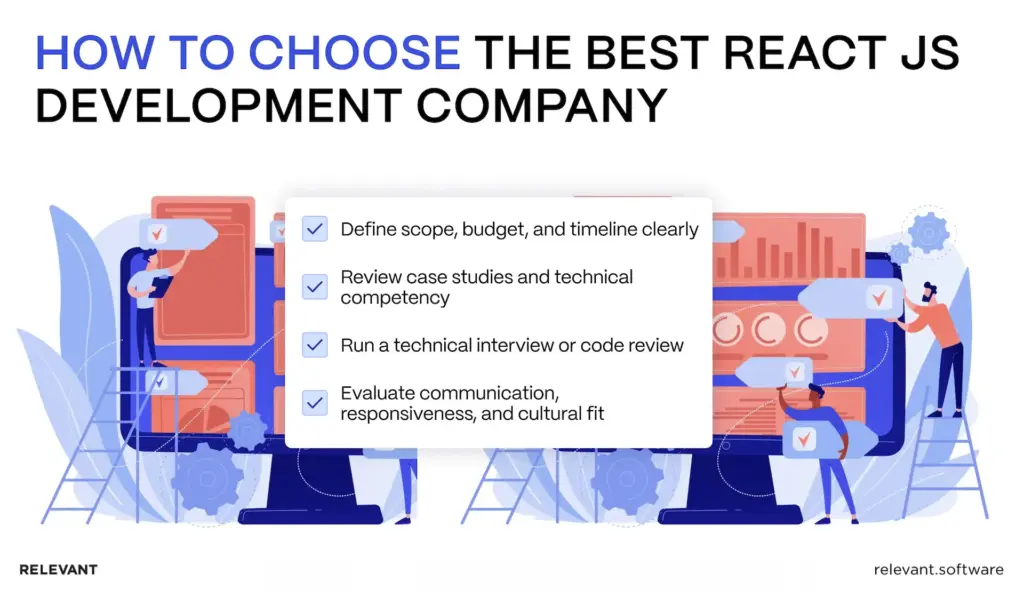
Define scope, budget, and timeline clearly
Treat the first call as a check of your own development process, because vendors can only estimate what you can explain. Start with outcomes and boundaries, then match them to specific needs and constraints for custom development.
A practical scope pack can include:
- A one-page goal statement for the front end and target users, with the core user experience you expect.
- 5–10 user journeys with acceptance criteria for web app development.
- An integration map for React applications, including auth, payments, analytics, and internal APIs.
- Non-functional targets for performance, accessibility, and security.
- Delivery constraints such as time zone overlap, release cadence, and compliance.
If you need a budget baseline for development services, use this reference on React developer hourly rate before negotiations start.
Review case studies and technical competency
A portfolio earns trust when it shows decisions, trade-offs, and outcomes. Ask for one walkthrough that includes what changed after launch and how the team handled issues in production. This is where track record, industry experience, and successful projects matter more than polished visuals.
Look for evidence of:
- Production operations and incident routines for stable software solutions
- A component strategy that supports reusable components and clear ownership
- Performance work that shows impact, not claims
- A testing approach that avoids flaky suites and protects delivery
- Integration experience that supports long-term digital solutions
If the roadmap includes enterprise concerns, review React for enterprise app development and compare it to what vendors show in real projects.
Run a technical interview or code review
A short technical screen reveals more than a deck. Focus on architecture instincts, code hygiene, and how the team makes trade-offs. This step also shows whether a vendor follows best practices in testing, state strategy, and release safety across React JS development.
Two formats work well:
- Code review (60–90 minutes): review a small repo and ask how they would restructure, test, and optimize
- Architecture interview (60 minutes): discuss state management, data fetching, boundaries, and how changes ship safely
If a vendor pushes heavy automation, ask how they apply using AI in software development without lowering review standards.
Evaluate communication, responsiveness, and cultural fit
The best predictor of steady delivery is how a team communicates under uncertainty. Ask who owns decisions, how risks get documented, and how status updates stay clear. This is where you learn whether the vendor can act as a trusted partner across months, not weeks.
Signals worth tracking:
- How quickly and clearly do team members respond in writing
- Who owns blockers and decision logs, and how they stay visible
- Sprint hygiene, demos, and release notes
- Estimation ranges that reflect real risk
- Tooling alignment across Jira, Linear, Slack, GitHub, and CI
Also, confirm capacity and stability. Team size matters if you plan to scale through staff augmentation or if you need steady cross-functional coverage for app development, including React Native work when applicable.
Final thoughts
The best React js development services selection has one practical goal: to reduce the cost of change. In 2026, most front ends evolve faster than their back ends, and the UI becomes the place where every new feature, experiment, and stakeholder request lands first. The right partner keeps that change affordable by building a UI that stays coherent as it grows, not by shipping a “perfect” first version.
A helpful way to close the decision is to pick one primary risk and choose the team that manages it best:
- If speed is the risk, choose the vendor that can demonstrate a repeatable delivery cadence, clear ownership, and fast feedback loops.
- If scale is the risk, choose the vendor that can explain component boundaries, shared UI strategy, and how they avoid a monolithic front end.
- If quality is the risk, choose the vendor that treats tests as part of delivery, not as a phase at the end.
- If integration complexity is the risk, choose the vendor that can describe failure modes and safe rollout patterns, not only “we integrate APIs.”
- If stakeholder alignment is the risk, choose the vendor that writes well, documents decisions, and flags trade-offs early.
When you make the choice this way, the comparison becomes clearer: you are not buying React skills, you are buying a delivery system that keeps the product easy to extend.