
Pharmacy Inventory Management Software: Predictable Stock Control, Waste Reduction, and Compliance
 Vadim StrukProduct Manager and Head of Business Analysis at Relevant Software
Inventory looks simple on a dashboard: units in, units out, reorder point met. Real pharmacy work rarely behaves that neatly. Demand shifts with prescriber habits, payer rules, seasonal illness, and therapy switches. Supply behaves even less predictably, with partial fills, substitutions, backorders, and short-dated lots that arrive when the shelf already feels full.
That gap between “inventory math” and real operations explains why pharmacies lose margin in quiet ways. Cash sits in slow movers, critical items run out at the worst moment, and expiry waste grows month after month. Meanwhile, compliance expectations continue to rise, particularly regarding traceability, controlled access, and audit-ready records.
This article explains what a pharmacy inventory management system does in day-to-day settings across retail, hospital, and chain environments. It also shows how to evaluate platforms and where healthcare software development services become essential, since integrations, scalability, and regulatory exposure define the real constraints.
What is pharmacy inventory management software?
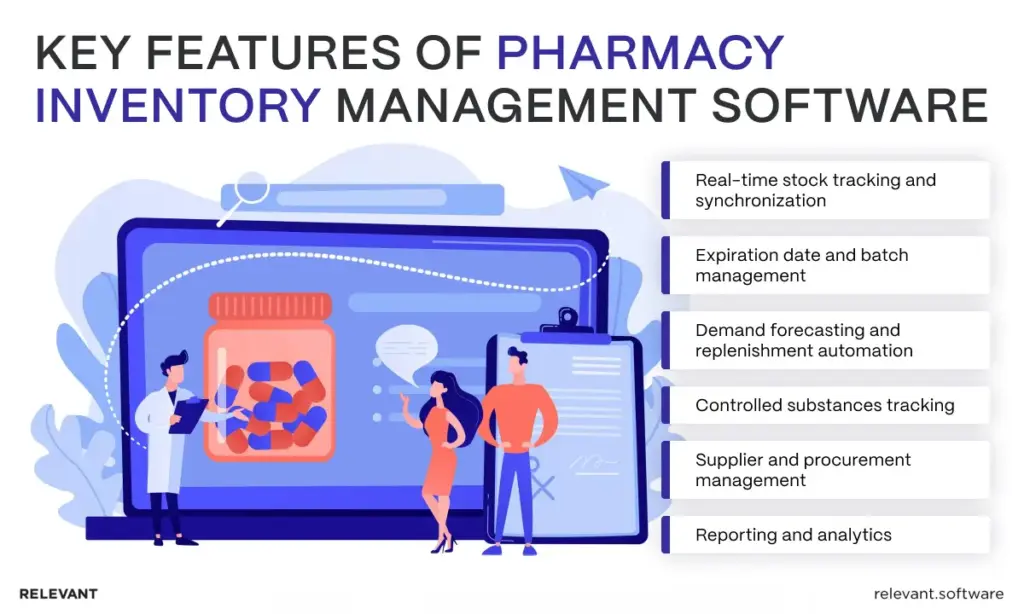
Pharmacy inventory management software records every meaningful stock event and updates the perpetual inventory accordingly. The goal remains simple: inventory levels must align with operational reality across receiving, storage, dispensing, returns, transfers, and adjustments. When that foundation holds, forecasting and procurement automation become useful instead of risky.
Good systems do more than track stock in a cleaner interface. They act as a controlled asset management layer, protecting the details pharmacies need every day, such as expiry dates, lot and batch IDs, storage requirements, and role-based permissions. This is also the moment many teams introduce barcode capture to reduce manual entry and boost accuracy, which aligns with patterns in the barcode inventory system.
To keep terminology clear, many organizations use different labels for similar capabilities. You may hear “pharmacy inventory software” in retail contexts, “medication inventory management” in hospital settings, or “drug inventory management software” when controlled workflows drive the discussion. The core purpose stays consistent: keep inventory truth accurate and defensible.
How pharmacy inventory differs from general inventory systems
Inventory in most industries focuses on availability and cost. Pharmaceutical inventory management carries clinical implications and regulatory scrutiny, so the record must remain defensible long after the moment passes. Below are the constraints that reshape design decisions.
Expiration management
Expiration sits at the center of margin protection. A pharmacy inventory system needs FEFO logic, configurable alerts, and daily workflows that keep short-dated items visible before they become write-offs. The best setups also support different rules per category, since a vaccine fridge and a front-store shelf behave differently.
Lot and batch traceability
Lot data becomes non-negotiable when recalls, adverse events, and supplier quality issues appear. A platform should capture lot and expiry at receiving, carry that data through transfers, and preserve it through dispensing. Without that chain, the pharmacy loses speed during recalls and credibility during audits.
Controlled substances
Controlled workflows require more granular access controls and a stronger audit trail than general stock. Drug inventory management demands role-based actions, approval paths for sensitive changes, and logs that support internal oversight. The system should make discrepancies easy to investigate, as unresolved variances can multiply risks.
Regulatory auditability
Auditors rely on verifiable records, approvals, and traceable source documents. A mature implementation records who changed what, why the change occurred, what source document supports it, and who approved it. A “notes field” rarely satisfies that need at scale. An event model with immutable logs usually does.
Cold-chain requirements
Cold-chain inventory forces the system to model “usable stock,” not only “present stock.” Temperature excursions, quarantine states, and release approvals can determine whether an item can be dispensed. That is why cold-chain workflows benefit from well-defined states, strict permissions, and a clear link between physical checks and system records.
Pharmacy inventory management: why inventory becomes a bottleneck in pharmacies
Inventory turns into a bottleneck when teams lose confidence in “inventory truth.” Once that happens, people slow down, add manual checks, and build parallel spreadsheets. That response feels safe, yet it usually amplifies risk because no single record stays complete.
In retail, the bottleneck often shows up as missed prescriptions and frequent substitutions. In hospitals, it shows up as delays, unit-level variance, and high-volume reconciliation work. In chains, it shows up as transfer chaos and inconsistent ordering behavior across locations. Over time, these issues also degrade cash flow because leaders compensate for it through bulk purchasing, then pay for it through expiries.
Here is what usually breaks first when inventory becomes operational drag:
- Replenishment shifts from routine to reactive, with frequent “rush” orders
- Counts drift, so staff add manual workarounds, and cycle counts expand
- Service levels fall as stockouts spike and substitutions become constant
Overstocking, expirations, and tied-up cash
Overstocking often starts as a simple promise: “If we keep more, we will never run out.” In reality, overstocking creates slow movers, increases expiry exposure, and raises shrink risk because more value sits idle. A system that supports perpetual inventory and FEFO decisions can reduce this pattern, but only if receiving, dispensing, and adjustments are all posted as a single event.
This problem becomes more pronounced in high-cost categories, such as specialty medications, cold-chain therapies, and items with short shelf lives. When procurement lacks reliable demand signals and lead-time modeling, ordering becomes defensive, and defensiveness gets expensive.
Stockouts and patient service disruption
Stockouts cost money in obvious ways, yet the hidden costs often sting more: staff time, escalations, patient dissatisfaction, and reputational erosion. A strong pharmaceutical inventory management software reduces stockouts by linking usage patterns to reorder logic and surfacing exceptions early. In clinical settings, availability also affects care workflows so that inventory accuracy can influence clinical coordination and internal service commitments.
Manual processes and fragmented systems
Fragmentation shows up as “almost correct” numbers across tools. A POS may decrement immediately, a dispensing platform may decrement later, and an ERP may post a nightly batch. When teams manually reconcile drift, human error increases, and adjustments become a catch-all. This is the moment many organizations realize that medication inventory management software is better than spreadsheets, as the process has outgrown manual coordination.
Compliance and audit exposure
Compliance risk increases when records lack traceability, have unclear access controls, or are inconsistently retained. Controlled-substance workflows, recall evidence, and adjustment approvals often pose the greatest exposure. If a platform cannot explain why inventory changed, the organization usually pays twice: first through operational inefficiency, then through audit friction.
How pharmacy inventory software works in practice
In day-to-day pharmacy work, inventory software matters only if it keeps up with real operations. A strong platform does more than count units. It connects dispensing, purchasing, finance, and compliance into one reliable flow, so teams can trust the numbers during busy shifts and audits.
Typical data flow
The data flow looks simple on paper, but each handoff must remain accurate. The inventory layer should act as the source of truth, with every stock event recorded once and shared across connected systems.
POS → Inventory → ERP → Accounting → Compliance systems
- POS/dispenser systems create usage events when medication is sold or dispensed.
- Inventory services update on-hand stock, lot status, expiry visibility, and location-level balances in real time.
- ERP receives purchasing and valuation data for procurement planning and operational control.
- Accounting receives financial postings for cost tracking, adjustments, and reconciliation.
- Compliance systems receive audit logs, traceability records, and evidence of controlled change.
When this chain is well designed, teams stop reconciling different versions of stock data. That reduces manual checks and supports faster decision making across pharmacy and finance teams.
Automation scenarios
Automation creates value when it removes repetitive work and surfaces risk early. In pharmacies, the strongest workflows support staff decisions instead of hiding them, so teams stay fast without weakening control. This becomes even more useful when the inventory platform also exchanges data with pharmaceutical manufacturing software, thereby improving visibility into batch status, supply constraints, and upstream traceability.
- Auto-reorder: The system generates reorder suggestions based on usage, lead time, safety stock, and supplier rules. That improves availability and reduces reactive purchasing.
- Expiry prevention: FEFO logic, early alerts, and short-dated stock tasks help teams move at-risk items before they become write-offs. This is one of the fastest ways to reduce waste.
- Recall management: Lot and batch traceability lets teams quickly identify affected items, isolate stock, and document actions. Speed matters here, and a clean audit trail matters just as much.
- Stock balancing across locations: The platform can suggest transfers between sites when one location has excess stock, and another faces a shortage risk. That helps optimize inventory across the network without overordering.
These workflows deliver the best results when the system explains each recommendation and logs what happened. Teams can review exceptions faster, maintain traceability, and maintain confidence in automation as volume grows.
Integration landscape
Integration quality often determines whether pharma inventory management software succeeds or becomes another partial tool. The platform needs to connect with the systems already running the business while preserving a consistent inventory record.
- Pharmacy Management Systems (PMS): PMS connections cover dispensing, patient-facing workflows, and operational stock movements. The core requirement is consistent event timing and accurate item mapping.
- ERP: ERP links handle purchasing, supplier management, and inventory valuation. If this connection is weak, procurement and inventory records drift apart.
- EHR: In hospital and clinical settings, EHR connectivity ties medication workflows to care delivery. This matters even more in complex health systems, where pharmacy activity affects multiple departments.
- Wholesalers: Wholesaler links handle order management, availability checks, substitutions, and delivery confirmations. Reliable wholesaler data speeds replenishment and reduces backorder surprises.
- Regulatory systems: Compliance and regulatory connections preserve audit evidence, controlled-substance records, and recall documentation. They are essential for audit readiness and long-term traceability.
As these connections expand, the real advantage comes from a stable event model and strong data governance. Together, they enable teams to scale pharmacy operations without sacrificing inventory accuracy or control.
The challenge increases in larger health systems, where pharmacy inventory must also align with hospital workflows and shared procurement policies. If the roadmap includes broader clinical and operational modernization, teams should align pharmacy inventory design with hospital management software development early.
In that environment, the platform has to do more than process transactions. It must maintain reliable inventory under heavy demand, preserve traceability, and enforce consistent control across sites.
Business benefits for pharmacies and healthcare organizations
Benefits become durable when the platform changes daily behavior. Better data alone rarely delivers ROI. Better execution delivers ROI: fewer stockouts, lower expiry waste, less manual reconciliation, faster recall response, and stronger audit readiness.
In financial terms, the most reliable outcomes come from three levers: reducing working capital, reducing waste, and improving labor efficiency. In operational terms, the most reliable outcomes come from availability, accuracy, and traceability.
Compact benefit list for executive reviews:
- Reduced expiry loss through FEFO execution and early alerts
- Higher availability through lead-time-aware replenishment rules
- Lower labor cost through fewer reconciliations and exceptions
- Stronger audit readiness through immutable logs and controlled access
These outcomes create the right conditions for the next stage: using AI in pharma to improve real-time decision-making while maintaining controls, compliance, and daily operations.
Types of pharmacy inventory management solutions
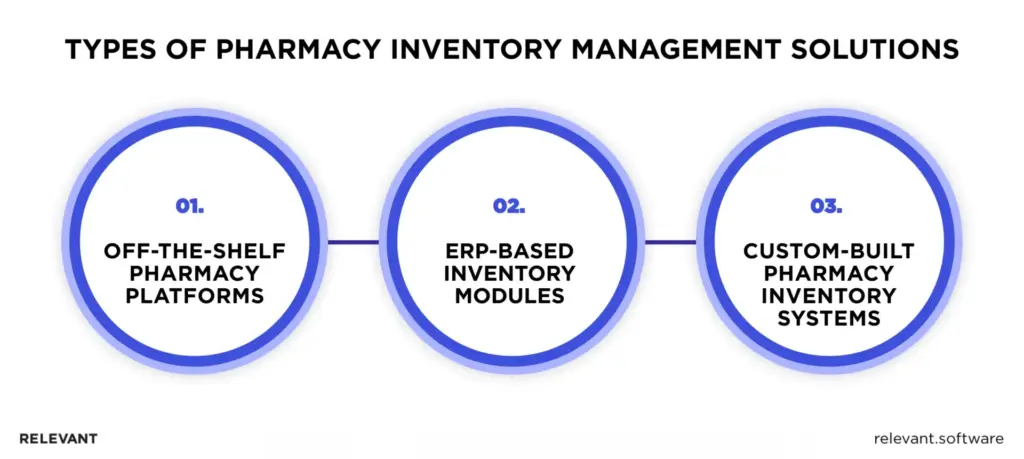
The “best” pharmaceutical inventory management solution type depends on where complexity sits. Some pharmacies need speed and standard workflows. Others need deep integrations, compliance-first evidence, and high performance at scale. Solution type also determines long-term change cost, especially when business rules shift frequently.
Off-the-shelf pharmacy platforms
Off-the-shelf inventory management software for pharmacy fits best when workflows align with common retail patterns and integration needs remain limited. They often deliver fast deployment, predictable licensing, and packaged training.
Limitations appear when edge cases dominate daily work. Workarounds accumulate, data integrity weakens, and teams return to manual reconciliation. It is the moment many organizations consider whether the platform supports the real operating model or only the ideal operating model.
ERP-based inventory modules
ERP modules can fit organizations that already centralize procurement and finance in one system and want governance consistency. This option can also simplify valuation and purchasing approvals.
Challenges arise when the ERP module lacks pharmacy-grade features such as FEFO execution, lot-level workflows, or near-real-time integration with dispensing. In that case, an ERP module may hold financial truth while operational truth drifts elsewhere.
Custom-built pharmacy inventory systems
A custom pharmacy stock management system is a good fit when complexity, compliance, and the integration scope define the project. It is common in large chains, hospitals, and multi-entity healthcare organizations where rules vary by location, and where traceability must remain strong.
A custom system also works well when you need tailored inventory management for pharmacy to support unusual workflows, advanced analytics, or strict audit-trail evidence requirements.
When custom pharmacy inventory software makes sense
Custom development creates leverage by removing structural friction that off-the-shelf systems cannot address without workarounds. The best business cases show recurring losses from expiries, recurring service disruption from stockouts, or recurring risk from weak traceability and audit evidence.
Custom work also becomes relevant when integration needs dominate. If inventory truth spans PMS, ERP, EHR, wholesaler feeds, and compliance archives, purpose-built pharmacy inventory management systems can unify the event model and preserve data integrity across systems.
Organizations that operate in regulated pharma contexts often connect inventory modernization to broader compliance-aligned delivery, which is a core part of pharmaceutical software development services.
Complex workflows and edge cases
Specialty drugs, cold chain, allocation rules, and high-volume environments often introduce edge cases that consume staff time and create hidden risk. If exceptions represent daily work rather than occasional work, custom workflows can reduce friction while improving governance.
This also includes multi-site balancing logic, partial pack handling, and rules that vary by payer or therapy. A system that encodes those rules can reduce manual decisions and improve consistency.
Regulatory and audit-driven environments
Audit-driven environments require evidence chains that remain defensible years later. That often means immutable logs, clear access controls, well-defined state transitions, and reliable audit and investigation retrieval.
Inventory management in pharmacy can enforce those controls directly in workflows rather than relying on staff memory and manual documentation. The result is a more predictable operating model under scrutiny.
Multi-system integration needs
Integration complexity often becomes the true “build vs buy” driver. Legacy PMS tools, custom reporting needs, and inconsistent master data can undermine even strong off-the-shelf platforms. A custom integration layer that normalizes events and preserves traceability can stabilize the ecosystem.
This is also where organizations define data governance: what becomes the system of record, how conflicts are resolved, and how downstream reporting tools receive consistent truth.
Performance and scalability requirements
High transaction volumes require strong performance, stable integrations, and resilient logging. Pharmacies cannot accept a platform that slows dispensing during peak hours. They also cannot accept a platform that loses audit evidence during outages or integration failures.
A scalable architecture often separates operational event processing from analytics views. That separation keeps real-time workflows fast while enabling flexible reporting.
Pharmaceutical inventory management system evaluation checklist
Demos often show similar screens. A thorough evaluation forces vendors to demonstrate behavior across real workflows and exceptions. The checklist below focuses on operational truth, compliance readiness, integration quality, and long-term change cost.
If you want a broader benchmark for what strong healthcare delivery partners tend to support, reviews of healthcare software development companies can help you frame maturity expectations.
What to test in a demo
Bring a test script that mirrors real pain points. Ask the vendor to execute each scenario end to end, including how the system logs events, handles exceptions, and produces evidence.
A practical demo script for pharma inventory management software includes:
- short-dated receipt and FEFO enforcement
- recall search by lot across locations
- controlled discrepancy with approvals and audit log output
- transfer between locations with synchronized inventory truth
Build vs buy decision points
Build vs. buy comparisons often fail when the conversation focuses solely on licensing. Total cost includes integration, workflow disruption, change effort, and compliance risk over time.
Decision-makers usually get clarity when they score options across:
- compliance, evidence quality, and retention needs
- integration scope and reliability
- scalability under peak transaction volume
- flexibility when business rules change
- governance controls for sensitive actions
Implementation plan that protects operations
Pharmacies cannot pause operations for a migration. Implementation must protect dispensing, receiving, and reporting continuity. A staged rollout with measurable gates reduces risk and avoids large-scale disruption.
Our case as an example of real work
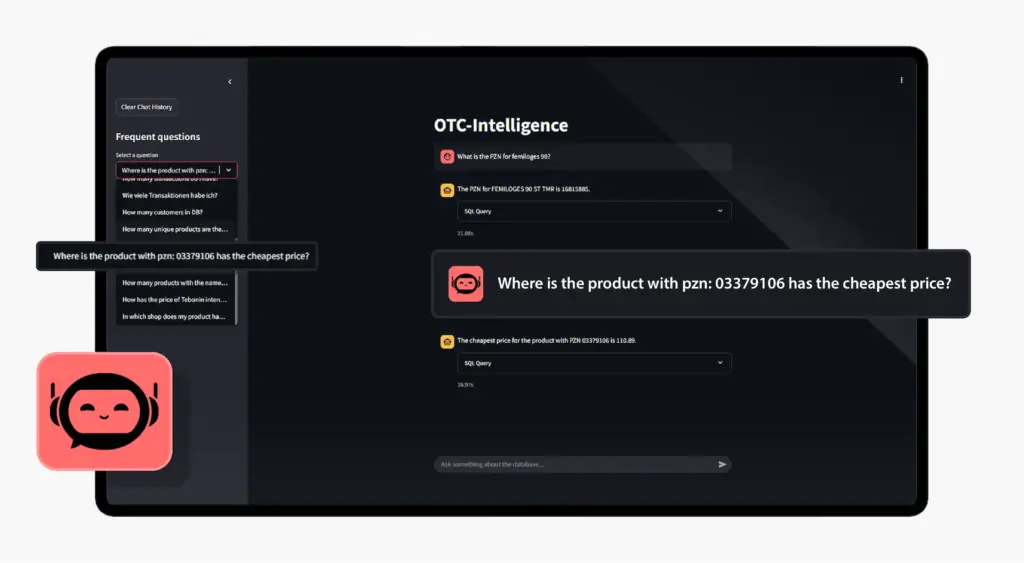
At a large scale, pharmacy procurement software has to do more than process data. It has to help people make decisions fast, during moments when timing directly affects cost and availability. This case shows how we turned a strained platform into a reliable tool that procurement teams could trust in real time.
A European healthtech startup needed procurement teams to see live price and inventory changes within seconds as data volumes grew to millions of records per day. Instead, dashboards froze, SQL queries stalled, and peak bidding windows became a risk. Relevant Software audited the platform and redesigned the architecture to restore speed and stability. We also added secure, natural-language querying, so teams could ask plain-language questions and get instant, structured answers without writing SQL or waiting for overnight batch reports.
As a result, the platform became faster, more stable, and far easier to use under pressure. The client got a system that could scale with demand and support better procurement decisions in real time, without forcing teams to depend on technical workarounds.
Building a scalable pharmacy inventory platform with Relevant
Growth pressure exposes the limits of a basic inventory tool very quickly. At that point, you need more than feature updates. You need a platform that remains stable while regulations evolve, integrations grow more complex, and operations expand across teams and locations.
Relevant Software builds pharmacy platforms for that environment. We approach them as regulated systems, where data integrity, audit readiness, and day-to-day performance carry equal weight. Our healthcare and pharma work includes the AstraZeneca case, which reflects the same priorities that matter in pharmacy inventory platforms: reliable data, strong integrations, and consistent performance at scale.
If you are planning discovery, architecture, custom integrations, or modernization, start with pharmacy management software development. If your roadmap also includes upstream production and supply workflows, we can align that foundation with pharmaceutical manufacturing software requirements from the beginning. Contact us.