
Top IoT Development Companies: Building the Connected Future
 Vadim StrukProduct Manager and Head of Business Analysis at Relevant Software
Not long ago, “smart” meant phones. Today, intelligence lives in products, buildings, and factories. Internet of Things (IoT) now supports daily operations so steadily that you notice gaps only when something fails, like lights that miss a schedule or a sensor that goes silent. Behind that ease lies a full stack of software and infrastructure built by IoT development companies.
They set device rules, secure data flows, build the cloud foundation, and deliver apps that keep supply chains visible, hospital equipment compatible, and machines able to diagnose themselves.
For CTOs, CIOs, and founders choosing between building in-house or outsourcing, the market can feel crowded. Many vendors connect devices; far fewer turn raw data into reliable systems that protect information and prove ROI. The right partner offers more than links between things. It offers confidence.
The next sections show how IoT moved from hype to core infrastructure and introduce seven IoT development firms shaping the connected future.
Comparison table: Top IoT companies at a glance
This table is a quick way to narrow a long list. It is not a final verdict; think of it as your shortlisting aid before deeper due diligence.
| Company | Core Services | Locations | Clutch Rating / Reviews | Notable Clients |
| Relevant Software | Custom IoT software development, IoT consulting, edge-to-cloud integration, data analytics | HQ in Lviv (UA) • Offices in Poland and Spain • Remote teams worldwide | 4.9 / 5 ⭐ (31) | Airthings; Astrazeneca; Volkswagen; RED Driver Training |
| Softeq | Embedded engineering, firmware development, mobile and cloud IoT solutions | USA (HQ in Houston) • Germany • Mexico • Lithuania | 4.9 ⭐(27) | Intel; NVIDIA; Verizon |
| Iomico | Product design, IoT prototyping, custom app development for smart devices | Poland • USA • Argentina | 4.8 ⭐(19) | Sleepme; Byte Technology; BeadedStream |
| ArcTouch | Connected apps, UX design, mobile IoT interfaces with cloud integration | USA (San Francisco and New York) | 4.9 ⭐(37) | 3M Filtrete; HP; Hawaiian Airlines |
| Webskitters | IoT application development, web and mobile platform integration | India (HQ Kolkata) • USA • UK | 4.9 ⭐(101) | Rad Golf; Yamatrack |
| Cogniteq | IoT consulting, hardware engineering, AI integration, full-stack development | Lithuania • Belarus • USA • Denmark | 4.9 ⭐(42) | Dog Tracker Nano |
| Apriorit | IoT software security, custom platforms, cloud architecture, R&D support | Poland • Ukraine • Cyprus • USA | 4.9 ⭐(42) | OPSWAT; Strivacity |
Why IoT development matters today
IoT development basically connects your physical world to your digital one. Devices send signals about what’s happening right now, the platform checks that everything is secure and coming from the right source, and the app turns that information into something you can actually act on. When this loop works, decisions get faster, safety improves, and teams stop relying on assumptions.
And this plays out everywhere. In manufacturing, machines “tell” you when they’re about to fail, so maintenance teams can fix the issue before a line goes down. In healthcare, equipment reports where devices are and how they’re performing, so staff don’t waste time searching for devices and can catch early clinical trends sooner. In logistics, trucks and containers share their locations and conditions, making it easy to reroute shipments before delays turn into customer complaints. In buildings and energy, meters and controllers quietly balance comfort and efficiency, keeping bills predictable even when demand spikes.
All of this follows the same simple loop: assets talk, systems confirm and protect, and applications help you make the right move. Once that loop runs across your operations, things shift from reacting to predicting. Less downtime, fewer surprises, and decisions based on what’s actually happening in the moment.
Learn more in our IoT product development guide.
What businesses gain from IoT software development
A solid IoT partner provides your team with clearer visibility, greater control, and faster decision-making. With the right IoT development company, you stop running tiny pilots that never scale and start getting real, reliable results. The benefits below highlight what leaders experience once devices, data, and people finally work together through well-designed platforms and practical applications.
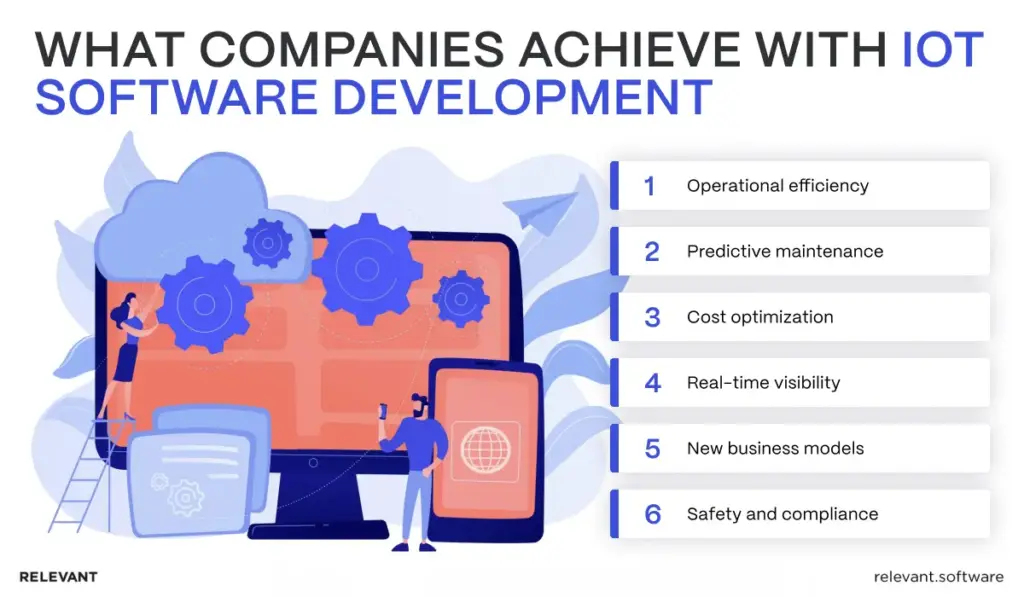
Operational efficiency. IoT turns device signals into decisions that improve daily work and long-term results. McKinsey’s 2024 explainer on IoT value creation shows significant, operations-driven gains across functions.
Predictive maintenance. By analyzing machine data, companies predict wear before breakdowns. According to Deloitte, predictive maintenance programs reduce downtime by 30–50% and maintenance costs by 10–40%.
Cost optimization. Connected operations improve returns on energy, labor, and assets. McKinsey estimates the overall economic value of IoT will reach trillions by 2030, with a large share tied to efficiency and waste reduction in core operations.
Real-time visibility. Live IoT data replaces guesswork. Supply chain teams see location, temperature, and inventory levels. Walmart is rolling out ambient IoT sensors from Wiliot to track 90 million pallets — everything from location to temperature to how long they sit in one place. All that data feeds directly into their AI systems, enabling real-time decision-making. And they’re not alone: IDC’s 2024–2025 supply-chain research shows that track-and-trace is now a top priority for companies that need better visibility and stronger compliance.
New business models. IoT also enables “as-a-service” business models, in which companies charge for uptime or usage rather than for the hardware itself. Rolls-Royce’s “Power by the Hour” program is the classic example: IoT data tracks how their engines perform, how much they’re used, and when they need service, and that information directly drives billing and proactive maintenance.
Safety and compliance. Sensors flag gas leaks, overheating, or unsafe conditions and trigger instant alerts. Smart buildings log evidence for audits. Security and compliance IoT testing covers device identity, update signing, data retention, and access controls, which help teams pass audits with confidence.
Benefits set the direction, but execution depends on who builds and runs the system. Next, define what makes top IoT software development companies, so the selection reflects a delivery track record, security practices, cost discipline, and a willingness to own results over the long term.
What makes a great IoT development company?
The right IoT partner does far more than connect a few devices and dashboards; they design systems that think, adapt, and deliver insights that change how a business operates. As global IoT spending moves past $1 trillion, the challenge isn’t deciding whether to invest in connected technology — it’s finding an IoT development agency that can turn that investment into a measurable impact.
Many vendors claim expertise in IoT software and hardware integration, but only a few can prove they’ve built platforms that stay secure, scale reliably, and deliver consistent performance in real-world conditions. The best IoT software development companies understand that success depends on precision engineering, deep domain knowledge, and the ability to align each solution with a company’s strategic objectives.
So, what truly separates great IoT solution providers from the rest?
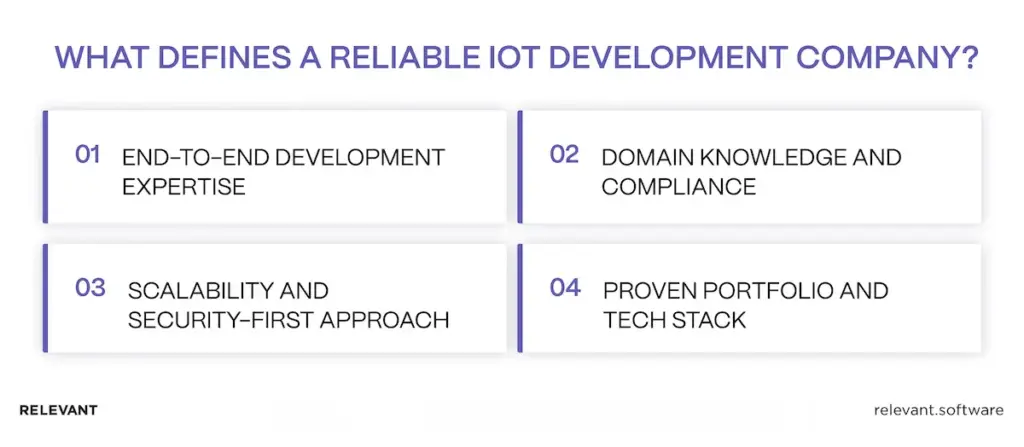
End-to-end development expertise
A capable IoT development firm owns the entire path from device to decision. Teams set up secure device connectivity, design gateways, and implement protocols that fit the environment. They map clean data pipelines, align storage with query needs, and build applications that guide action. Internet of Things developers who handle firmware, APIs, analytics, and UX under one plan eliminate gaps across layers and reduce delivery risk.
Domain knowledge and compliance
Complex IoT projects move faster when standards are set from day one. In healthcare, that means HIPAA and ISO 13485. In manufacturing, ISO 9001 requires traceability. In automotive, ISO 26262 and GDPR. When your partner builds with these standards in mind, data stays protected, audits take less time, and timelines remain stable. Teams who understand the environment they are building for, whether it is a shop floor, a hospital ward, or a vehicle fleet, make decisions faster and earn trust much sooner.
Scalability and security-first approach
Growth and security must stand up under pressure. Top IoT app development companies use unique device identities, mutual authentication, and encryption in transit and at rest. They support secure firmware updates with signed binaries and clear rollback. APIs remain reliable under load and integrate cleanly with enterprise systems. This foundation lets new sites, users, and data streams come online without rewrites or fragile workarounds.
Proven portfolio and tech stack
Results appear in the field, not just in slide decks. Leading Internet of Things development companies point to case studies with uptime, user adoption, and cost improvements. They build on Azure, AWS, or Google Cloud, choose the right services for stream processing and storage, and align toolchains with the client’s team. A portfolio like this signals they can deliver, support, and evolve the product after launch.
If the shortlist already includes several IoT software companies, use these criteria to compare depth, not slogans. The partner that wins should connect devices with purpose, ship custom applications that fit real work, and strengthen the business relationship through transparent delivery and measurable results.
Top 7 IoT development companies in 2026
We’ve selected seven reliable IoT product development companies offering IoT development services and custom software development across various industries. These IoT firms stand out for a proven track record in production, strong technical depth, and dependable support from prototype to full-scale rollout, delivered through practical software solutions.
Relevant Software
Relevant Software ranks among the best IoT development companies in 2026 for its focus on reliability and clear delivery stages. The team works in healthcare, pharma, logistics, energy, and manufacturing, and ties each phase to a measurable business goal.
Services & platforms: The company delivers end-to-end IoT software development and IoT development consulting, including cloud services, data engineering, and web and mobile app development. The team builds dashboards with clear data visualization and connects solutions with ERP, MES, and EAM systems. Device fleets run on cloud platforms such as AWS IoT and Azure IoT Hub with centralised device management.
Key strengths: Small, senior teams of top IoT developers follow transparent roadmaps and include compliance from the start. Security covers the full lifecycle through device identity, encrypted communication, and signed updates, with agreed SLOs, uptime targets, and predictable long-term costs. All IoT work stays in-house, supported by a 98% staff retention rate that keeps delivery on time and on budget and reduces onboarding overhead for each new phase.
Ideal fit: Mid-market and enterprise companies that need the best IoT developers, tight risk control, and a predictable path to scale.
Softeq
Headquartered in Houston, Softeq is a full-stack IoT development company with strong software and hardware design expertise. The team delivers consumer electronics, healthcare, and industrial IoT solutions that connect devices, process sensor data, and handle real-time data processing across a scalable cloud platform.
Services & platforms: Softeq provides IoT development consulting, electronics design, embedded and firmware engineering, IoT hardware, gateways, mobile app development, user interfaces, cloud backends, data pipelines, and analytics. The company works with protocols and tooling for both industrial and consumer environments and delivers deployments on AWS, Azure, and Google Cloud with robust device management.
Key strengths: True end-to-end delivery across hardware and software, hands-on experience in industrial automation and wearables, and a careful, staged approach to secure rollouts at scale. This combination helps clients move from prototype to production with realistic expectations on reliability, security, and long-term maintainability.
Ideal fit: Companies that require strong hardware, robust software, and a stable path from prototype to production.
Iomico
Iomico is a custom IoT product partner with engineering hubs in the US, Poland, and Argentina. The company builds connected IoT devices and the software that runs them, with a strong focus on electronics design, real-time firmware, and edge AI powered by machine learning. Their goal is simple: move from prototype to production without surprises and keep IoT hardware update-ready in the field.
Services & platforms: Iomico covers electronics and PCB design, enclosure design, firmware, BSPs and drivers, Zephyr and Embedded Linux, OTA updates, edge AI, DevOps, cloud and web backends, and mobile apps.
Key strengths: They include deep hardware and firmware skills, a clear path to manufacturing, and strong support for secure updates and long-term maintenance of deployed devices.
Ideal fit. Companies that build hardware-led IoT products need deep firmware skills, secure update mechanisms, and a predictable path from prototype to full-scale manufacturing.
ArcTouch
Founded in 2009, ArcTouch is an IoT app development company headquartered in the United States with offices in Canada, the United Kingdom, France, and Brazil. The company designs software for connected products, with a strong focus on user experience and refined user interfaces. A 250+ person design team supports projects that span mobile apps, web applications, and cloud back ends that pair reliably with devices in the field, including Azure IoT Hub integrations.
Services & platforms: IoT app design and development, firmware integration, cloud back ends, and UX for connected products across consumer and industrial categories.
Key strengths: Product-ready UX, clean integrations between device and cloud stacks, and proven delivery for brand-name connected products.
Ideal fit: Firms that want a polished user experience, reliable integration between devices and cloud platforms, and clear product telemetry that supports dependable connected products.
Webskitters
Webskitters provides IoT development as part of a broader software offer that includes web, mobile, and digital software development services. The team focuses on practical sensor-to-cloud connections and custom apps that address day-to-day operational needs in smart cities and private deployments, backed by engineers who tailor platforms to specific needs.
Services & platforms: Services include IoT development, web and mobile applications, system integrations, and post-launch maintenance and support on modern cloud platforms.
Key strengths: Flexible engagement models, broad skill coverage across the stack, and a proven delivery record backed by reviews on trusted platforms.
Ideal fit: Value-focused companies that need reliable IoT and custom software delivery on a modern cloud platform, without a heavy hardware scope.
Cogniteq
Cogniteq is an IoT software company that helps organizations plan, build, and support connected systems across industrial and healthcare use cases. The team combines consulting expertise with full-cycle delivery, uniting embedded development and IoT data analytics to improve safety, uptime, and process control. Their focus on measurable outcomes and clear technical capabilities positions them as a reliable partner for structured, high-stakes environments.
Services & platforms: IoT and IIoT consulting, embedded software development, hardware support, rapid prototypes for validation, and application development for both devices and cloud platforms.
Key strengths: A balanced mix of advisory and engineering skills, strong focus on industrial operations, and a visible presence in IoT vendor shortlists.
Ideal fit: Organizations that want a mix of strategy and delivery, with particular emphasis on industrial operations or digital health solutions.
Apriorit
Apriorit focuses on security-first engineering for complex embedded and IoT software. The company develops medical devices, automotive systems, and other connected products that must maintain reliable data flows and strict security. Senior engineering leaders and a scalable delivery team support each project. Their specialists work across low-level components and cloud services so performance, safety, and compliance stay aligned end to end.
Services & platforms: Embedded and IoT software development, connected vehicle and fleet systems, patient monitoring solutions, and secure cloud components that connect device data into software platforms on modern cloud infrastructure.
Key strengths: Deep system-level expertise, strong security practices, and a mature delivery model supported by an experienced engineering team.
Ideal fit: High-risk companies that need advanced system expertise, robust security foundations, and dependable performance at scale.
Bottom line
These seven IoT applications development companies stand out from the 100+ IoT software vendors included in our research. Use this list to compare IoT partners based on architecture choices, delivery models, and proof of results rather than on broad promises.
The past five to eight years reshaped every layer of the IoT stack, and the momentum continues. Conditions now favor teams that move with precision and deliver clear outcomes. As a result, newer, smaller providers often gain meaningful traction by addressing specific gaps with sharper products and faster execution.