
Impact of AI on Software Development
 Andrew BurakCEO and Founder at Relevant Software
Claude, ChatGPT, GitHub Copilot, CodeGuru, and OpenAI Codex have turned the software development landscape upside down (in a good way, of course). These tools help tech teams write, review, and optimize code with the precision of a laser and the speed of a caffeine-fueled coder. According to McKinsey’s latest research, businesses that use AI in their development processes can boost productivity by as much as 40%. The potential of large language models to help us do more in less time with fewer errors is nothing short of remarkable.
But how far can this revolution go with rapidly advancing AI chatbot development services? Will AI replace programmers, or are we safe from our future robot masters (at least for now)? We decided to shed some light on the complex world of AI in software development.
Current Picture: How AI Transforms the Software Development World
The integration of AI into software development is transforming the industry by leaps and bounds. In a test with 40 McKinsey developers, AI-based tools delivered remarkable speed improvements. They found that documenting code for better maintainability was completed in half the usual time. Writing new code also took nearly half the time, and code optimization tasks were done in about two-thirds of the time normally required.
Specific Roles of AI In Software Development
- Automating the Mundane: AI now automates repetitive tasks like code generation, testing process, and bug fixing. Developers don’t have to spend hours fixing bugs anymore. They can let machines handle the boring tasks and enjoy the more interesting parts of their jobs.
- Boosting Code Quality: AI can analyze vast amounts of code to identify patterns and potential vulnerabilities. This allows developers to generate cleaner, more secure code with fewer bugs. For example, GitHub Copilot has been trained on billions of lines of code and can suggest entire blocks of code, which speeds up the development process and helps reduce errors.
- Smarter Project Management: AI in software development can predict potential roadblocks and bottlenecks in development projects. This foresight enables developers and project managers to allocate resources more effectively and adjust timelines proactively for smoother and more efficient development cycles.
- Personalized Development Assistance: AI-powered tools can suggest code completions, recommend best practices, and even identify potential improvements in available code. This customized guidance helps developers write more efficient code and make informed decisions throughout development.
This comparison shows the transformative impact of AI in software development.
| Aspect | Programming Without AI | AI-Assisted Programming |
| Code Writing | Manual code generation; developers write each line of code themselves. | AI-assisted coding with tools like GitHub Copilot, suggesting code snippets and auto-completing lines. |
| Debugging | Developers manually search for and fix bugs in the code, which can be tedious and requires an in-depth knowledge of the codebase. | AI-powered debugging tools identify bugs and suggest fixes automatically. |
| Code Review | Code reviews are conducted by peers, which can be a slow process depending on the availability and workload of team members. | AI-augmented tools provide instant code reviews, highlighting potential issues and improvements. |
| Optimization | Developers need to manually optimize code, which requires extensive knowledge of best practices and performance considerations. | AI algorithms optimize code for performance and efficiency automatically, simplifiyng technical debt management. |
| Documentation | Developers create and update documentation manually, which can be tedious and is often neglected. | It keeps documentation comprehensive and up-to-date based on code AI analysis. |
| Error Detection | Errors are typically detected under compile time or runtime, often after significant development has already occurred. | AI provides immediate feedback through error detection and code corrections. |
| Productivity | Productivity varies based on the individual developer’s skill and experience, and manual processes can slow down development. | AI enhances productivity through smart suggestions and repetitive task automation. |
| Creativity | Developers draw on their expertise and background to develop creative solutions and introduce new ideas. | AI inspires creativity by innovative approaches and solutions. |
| Maintenance | Frequent code updates and maintenance involve manual work, which can be labor-intensive and prone to mistakes. | AI predicts necessary updates and automates routine maintenance tasks, keeping code up-to-date and reducing manual workload. |
| Security | Security vulnerabilities are identified through manual review or after a breach has occurred, making it difficult to ensure comprehensive protection. | AI constantly checks for security weaknesses, delivering instant alerts and automated repairs to boost the security of the codebase. |
| Testing | Developers conduct extensive manual testing across various scenarios to ensure code functionality and stability. | AI testing tools automate test case creation and execution, improving coverage and accuracy while saving time. |
As you might notice, AI cuts down on manual tasks, enhances skills through smart automation, and boosts software development companies. This transformation makes the process of AI software development more efficient, precise, and innovative.
Types of AI: Overview
Artificial Intelligence (AI) is defined as a technical and scientific field dedicated to creating systems that produce outputs such as content, forecasts, recommendations, or decisions based on human-defined goals [ISO/IEC 22989:2022]. While this technical definition is precise, what does it mean in simple terms?
AI is essentially a functional instrument that helps with specific, complex tasks. Its power comes from the algorithms and machine learning techniques it employs, but it demands vast amounts of data and endless repetition. Think of algorithms as intelligent systems that can analyze various pieces of information about a subject. When this algorithm is fed a large amount of training data, it creates a machine-learning model. This model can then take in new data and make decisions based on what it has learned.

Different types of AI are classified based on their level of adaptability and performance compared to humans. Advanced functions at a level similar to humans, while basic AI performs with more limited capabilities. Using this system, AI falls into four types:
1. Reactive Machines
These are the oldest type of artificial intelligence, with no memory or learning ability. They react to a limited set of inputs. Take the example of IBM’s Deep Blue, which famously triumphed over chess Grandmaster Garry Kasparov in 1997. Great at chess, but remembering birthdays? That’s another story.
2. Limited Memory Machines
These systems can do everything reactive machines do, but with a bonus: they can learn from historical data. They gather large volumes of training data, which they utilize to solve future problems. Almost all AI applications we use today, from recommendation systems to self-driving cars, fall into this category. They might not remember where they parked last week, but they know how to avoid that pothole every time.
3. Theory of Mind
AI at this level will understand human emotions, beliefs, and thoughts, treating each person as an individual shaped by various factors. While researchers are working on artificial emotional intelligence, a true theory of mind, AI is still a distant dream. It’s like trying to explain feelings to your smartphone—interesting, but we’re not quite there yet.
4. Self-aware AI
At this stage, it becomes self-aware of emotions, needs, beliefs, and possibly its own desires. Picture the “Terminator” scenario where AI thinks about self-preservation, potentially clashing with humanity. We’re talking about the next level after the theory of mind, but don’t worry; it’s likely still centuries away.
5. Advanced Machine Learning
Many experts suggest that what we commonly call AI in everyday life is actually advanced machine learning, a precursor to genuine artificial intelligence, or “general artificial intelligence” (GAI). These machine learning technologies enable machines to undertake tasks that only humans could do in the past.
- Machine Learning (ML): ML enables AI models to learn from data through supervised learning with labeled information or unsupervised learning that identifies patterns in unlabeled data. Reinforcement learning, another branch, involves learning through trial and error.
- Natural Language Processing (NLP): NLP allows machines to understand and respond to human language. This technology powers applications like chatbots, language translation services, and sentiment analysis tools, which make human-computer interactions more seamless and intuitive.
- Neural Networks: Inspired by the human brain, neural networks consist of interconnected nodes (neurons) that process information in layers. They are fundamental to deep learning (DL) and are crucial for recognizing images and processing speech.
- Computer Vision: This technology lets computers interpret and understand visual information. It’s utilized in applications ranging from facial recognition to autonomous vehicles, enabling machines to “see” and appreciate their surroundings.
What is an AI Technique?
In the real world, knowledge often has challenging characteristics:
- Immense Volume: The amount of knowledge is vast and nearly unimaginable.
- Disorganized and Unformatted: It is not always well-organized or neatly formatted.
- Constantly Changing: It evolves and changes continuously.
AI techniques provide a method to organize and utilize this knowledge efficiently, ensuring that:
- Perceivability: It is understandable to the people who provide it.
- Modifiability: It can be easily modified to correct errors.
- Versatility: It remains useful in many situations, even if it is incomplete or inaccurate.
The use of AI techniques speeds up the execution of complex programs, which results in higher efficiency and effectiveness.
Key AI Components
AI applications rely on three essential components: data, algorithms, and human feedback.
- Data: The core element of artificial intelligence in software development is data. These datasets, sourced internally (e.g., trading desks, customer histories) and externally (e.g., social media, public filings) in structured and unstructured formats, drive AI applications by identifying patterns and making predictions. Continuous learning from human reviews and new information refines these predictions.
- Algorithms: Algorithms are sets of step-by-step instructions that solve specific problems using input data. Unlike traditional programming, AI algorithms are not explicitly programmed to perform tasks; instead, they learn to perform tasks through data exposure.
- Human Interaction: As data is curated and algorithms process it to generate outputs such as classifications and predictions, human experts review these results for accuracy and relevance. Such human intervention is necessary for AI systems to produce relevant and correct results, which minimize inefficiencies or potential risks.
AI Development Trends in 2026
To remain competitive, IT professionals and businesses must keep up with the latest AI trends. Here’s short overview:
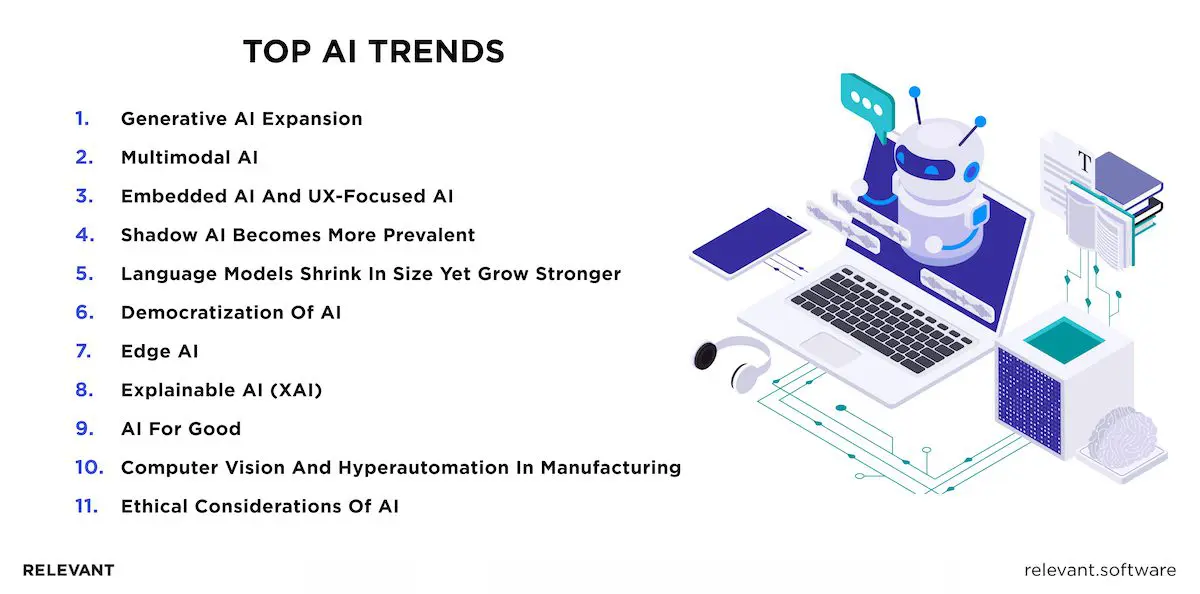
- Generative AI Expansion — Extending into video, 3D models, and sensory experiences; expected to match median human performance by the end of the decade.
- Multimodal AI – Processes text, audio, video, and images together for richer, more intuitive applications.
- Embedded AI and UX-Focused AI – AI integrated into third-party systems to enhance user interactions and customer experience.
- Shadow AI – Employees using AI without IT approval, driving innovation but introducing security and oversight risks.
- Smaller but Stronger Language Models – Small Language Models (SLMs) delivering high performance with fewer parameters and lower computational demands.
- Democratisation of AI – Cloud tools and pre-trained models are making AI accessible to businesses of all sizes.
- Edge AI – Data processed at its source for faster decisions, critical for IoT and autonomous vehicles.
- Explainable AI (XAI) – Making AI decision-making more transparent and interpretable for human understanding.
- AI for Good – Using AI to tackle global challenges like climate change, poverty, and healthcare.
- Computer Vision and Hyperautomation – Transforming manufacturing with greater precision, speed, and safety monitoring.
- Ethical Considerations of AI – Growing focus on bias, transparency, and accountability, with regulation on the horizon.
How AI is Changing Software Development?
As AI technology evolves, it brings up conversations about the future of artificial intelligence software development and whether it might reduce the need for human programmers. However, fears of AI completely overtaking the role of programmers seem a bit premature.
In truth, AI is far from ready to replace software developers. Even with its customization capabilities and targeted applications, its limitations are too significant.

However, it is changing the way software engineers work. 70% of developers say that AI coding tools enhance their ability to complete tasks and boost productivity. Experts agree that while AI can automate repetitive tasks and assist in debugging, 80% of programming jobs will still need a human touch.
Complex Coding Requirements
Some projects require developers to manage multiple, often conflicting, requirements. While AI can respond to specific prompts and generate code snippets, it struggles to manage complex criteria while maintaining a holistic project view. Developers ensure that all aspects of the project align with the overall goals and expectations, something AI currently cannot do.
Contextual Outputs and Organizational Knowledge
AI-generated code often lacks the context of an organization’s unique preferences and standards. That means the programs it creates might not meet your security, performance, or compliance requirements. Human developers must tailor AI outputs and align software development with the company’s strategic initiatives and organizational knowledge.
Broader Strategic Approaches
AI excels at performing narrowly defined tasks, but it falls short when aligning its outputs with broader strategic goals. While AI can create functional programs, human developers must ensure that these programs fit within the larger framework of the organization’s software ecosystem. This includes stylistic consistency, functional alignment, and long-term strategic planning.
Autonomous Action
AI in software development relies on inputs to generate outputs. Current AI systems, particularly generative ones, create text or code based on prompts and predict subsequent elements. However, they lack true autonomy. AI can’t independently decide to undertake a task without explicit instructions, which means human oversight is always necessary to guide and refine AI-generated content.
Domain Expertise
In the finance, healthcare, and scientific computing sectors, programmers with domain knowledge will be essential for success. They can employ their experience of the specific challenges and regulations to develop customized software solutions that effectively address those needs.
The future of artificial intelligence software development doesn’t pit humans against AI; instead, it envisions a collaborative partnership between the two. Programmers who embrace AI tools and hone the skills to work alongside them will be best positioned for success. They were more than twice as likely to report higher happiness, fulfillment, and flow levels.
Our View on AI in Software Development:
At Relevant, we’re big fans of the AI revolution. We train our developers extensively to harness the power of AI, making their work faster and their products top-notch.
So, whether you want to leverage artificial intelligence software development for enhanced efficiency or need a reliable AI-assisted software development company to bring your vision to life, we are here to help.
Relevant ensures your business gets top-tier, time-zone-aligned AI software engineers. By partnering with us, you can prioritize innovation and business expansion, confident that your projects are being expertly overseen. Contact us!