
Databricks vs Snowflake: Architecture, Cost, Scale, and Use Cases
 Ostap DribniukSenior Software Engineer
Why does the Databricks and Snowflake comparison make sense? Because the platform choice determines whether analytics and AI scale smoothly or become constant alignment work. The right fit enables the CTO to deliver faster with less friction: late data updates are rare, KPIs are predictable, schema changes remain manageable, analysts work from shared definitions, and ML moves into production rather than stalling at the demo stage. Adoption then becomes a strength, not a stress test.
This guide compares Databricks and Snowflake by examining the production decisions that drive outcomes: architecture trade-offs, workload isolation, pipeline patterns, concurrency under real load, and the cost mechanics that shape total ownership. If data management services are part of your plan, treat this article as a decision framework. It helps you separate real operating advantages from nice-to-have features and link each to its production impact.
Databricks vs Snowflake: quick overview
A quick overview helps because many evaluations get stuck in feature parity debates, even though the real decision comes down to workload shape and team skills. Use this section as a baseline, then map it to your data engineering, BI, and ML roadmap.
What Databricks is
Databricks positions the lakehouse as a way to combine the flexibility of a data lake with the reliability of a data warehouse, using Spark-based compute and a storage layer designed for table reliability. In practice, teams use Databricks when they need one platform to support data engineering, streaming, data science, and production ML, especially when unstructured data or complex transformations drive product value.
Typical Databricks workloads include:
- Large-scale data engineering on object storage, with complex transforms and schema evolution
- Streaming and near real-time pipelines for events, telemetry, and operational signals
Machine learning training, feature engineering, and model deployment workflows - Advanced analytics where SQL blends with Python, Spark, and ML libraries
What Snowflake is
Snowflake centers on a cloud data warehouse model with compute and storage separated, enabling teams to run multiple independent compute clusters (virtual warehouses) on governed data without managing server infrastructure. It suits organizations that want strong SQL performance, workload isolation, and broad compatibility with the modern BI ecosystem, especially when structured reporting and cross-team analytics are central to the platform.
Typical Snowflake workloads include:
- Business intelligence and reporting with high concurrency and predictable SQL patterns
- ELT-style pipelines where transformation logic lives in SQL and scheduled tasks
- Data sharing and governed access across business units or partners
- Enterprise analytics where operational simplicity matters as much as raw flexibility
Architecture comparison: lakehouse vs cloud data warehouse
Architecture determines more than where data sits. It shapes failure modes, cost behavior, governance models, and how teams ship new use cases under pressure. The difference between Snowflake and Databricks shows up in these building blocks, not in marketing labels, so this section stays concrete.
Databricks architecture
Databricks implements the lakehouse pattern on top of object storage such as S3, ADLS, or GCS, then adds compute clusters and a table layer that supports reliability features. Delta Lake plays a central role by extending Parquet with a transaction log that supports ACID behavior and scalable metadata, making “data lake tables” behave more like warehouse tables. Apache Spark powers the compute side across clusters and SQL warehouses.
Key architectural implications for enterprise teams:
- Data storage stays in cloud object storage, which can reduce lock-in risk and improve portability
- Data processing scales via clusters, which can deliver strong throughput but requires runtime tuning discipline
- Delta Lake can unify batch and streaming table patterns, which helps when late data and updates matter
A unified workspace often supports analytics, ML, and engineering teams, reducing tool sprawl but increasing governance requirements.
Snowflake architecture
Snowflake describes a three-layer model: a storage layer, compute resources that execute queries, and a cloud services layer that handles coordination tasks such as authentication, access control, and query dispatch. The compute side runs through virtual warehouses, which are clusters of compute resources that execute SQL and DML operations. Because warehouses stay independent, teams can isolate workloads by function, business unit, or environment (dev, test, prod) without sharing the same compute pool.
Key architectural implications for enterprise teams:
- Workload isolation becomes straightforward because warehouses separate compute by design
- Governance often concentrates in the services layer and role model, which simplifies enforcement patterns across teams
- SQL-first development works well for standardized analytics and reporting, especially when many users query at once
Cost control depends on warehouse sizing, runtime behavior, and policy controls, which become finance and platform governance topics.
Data engineering and pipelines
Pipeline design often determines the winner because pipelines carry operational risk: retries, backfills, schema drift, data quality checks, and late-arriving events. A platform can look “cheaper” in a demo, but become expensive in production if operational patterns do not align with the tool.
Ingesting and transforming data in Databricks
Databricks leans on Spark for pipelines, which supports batch and streaming patterns across diverse sources and formats. Delta Lake’s design supports streaming and batch processing, with convergence and reliability features that help teams manage changes to production tables.
Practical strengths you can expect when the team has Spark maturity:
- Unified pipeline code where transformations, enrichment, and ML feature prep share one execution model
- Strong fit for unstructured data and mixed-format ingestion, especially when data quality varies by source
- Clear path for near real-time processing when business logic needs low-latency signals
- Flexible orchestration patterns through platform-native workflows and third-party tools (Airflow, Prefect, cloud schedulers), depending on your stack
Common pitfalls to plan for early:
- Cluster sizing choices affect performance and cost, so teams need baselines and guardrails
- A lakehouse succeeds only when table design, partitioning, and file layout stay disciplined
Data pipelines in Snowflake
Snowflake pipeline design often follows an ELT pattern: ingest raw data into tables, then run SQL transformations on those tables using scheduled tasks and table-centric workflows. Virtual warehouses provide compute for load and transform operations, allowing teams to isolate ingestion and transformation compute.
Snowpipe supports automated ingestion, enabling teams to continuously push data without hand-built loaders. If your operational systems are microservices-based, define service-level ownership and data boundaries early; otherwise, ELT can become a single shared “mega-model” with no owner. A clear database for microservices approach helps keep domains clean and transformations explainable.
Pipeline strengths for SQL-centric organizations:
- SQL-first transformations reduce tool sprawl when the team already standardizes on SQL
- Independent warehouses simplify the separation of ingest, transform, and BI compute
- Mature connectors and ecosystem integrations reduce custom integration work in many cases
- Strong fit for structured feeds from SaaS systems, ERP exports, and operational databases
Common pitfalls to plan for early:
- Some transformations become expensive when they mimic Spark-style processing patterns, especially if teams force non-SQL workflows into SQL-only jobs.
- Cost governance requires resource monitors and warehouse policies, so “one more dashboard” does not lead to surprise spend.
Analytics and business intelligence capabilities
BI success depends on concurrency behavior, semantic consistency, and predictable query performance under load. Many teams also need interoperability with tools such as Power BI to maintain stable reporting workflows as the platform evolves.
BI and SQL analytics in Databricks
Databricks supports SQL analytics on lakehouse tables, enabling BI tools to query governed data while engineering teams retain ownership of pipeline logic. The lakehouse model can work well when business intelligence teams need access to curated tables, while data engineering and ML teams operate on the same platform.
For BI teams, Databricks tends to fit best when:
- Analysts need SQL access plus collaboration with engineering teams that write Spark and Python
- The company wants one platform that supports BI, data science, and ML without moving data across tools
- The main constraints come from data quality and metric definition, not only query speed
Implementation guidance that avoids reporting chaos:
- Establish a semantic layer strategy early, so metrics remain consistent across BI tools
- Treat curated tables as products, with owners, SLAs, and change control
BI and analytics in Snowflake
Snowflake’s architecture supports SQL analytics at scale by isolating BI workloads from ingestion and transformation. This model often performs well for high-concurrency reporting because teams can provision dedicated BI warehouses sized to the demand profile.
Snowflake often becomes the default choice when:
- BI drives most value, with heavy use of SQL dashboards and standardized reporting
- Teams need predictable concurrency behavior during business hours
- The organization wants to reduce operational complexity for analytics users
Practical steps that improve outcomes:
- Split warehouses by workload class (BI, ELT, ad hoc exploration) to protect critical dashboards
- Align BI refresh schedules with warehouse autosuspend and cost policies, so finance can forecast spend
Machine learning, AI, and advanced analytics
ML capability rarely means “can the platform run notebooks.” It means reliable features, reproducible training, model governance, and safe deployment paths that connect to production systems. This section focuses on what matters once ML moves past prototypes and starts carrying business risk.
Databricks for ML and AI workloads
Databricks has strong gravity for ML because it integrates data engineering and ML workflows on a single platform. MLflow provides experiment tracking and lifecycle capabilities that help teams move from experiments to managed deployment patterns. With a lakehouse foundation, the platform can support feature pipelines that reuse the same tables as analytics, which reduces duplication when teams align ownership.
Where Databricks typically shines for AI workloads:
- Large-scale feature engineering on event data and unstructured data
- Model training that needs distributed computing, especially when data volumes grow fast
- Collaboration workflows where notebooks, code repos, and data assets live in one governed environment
- Teams that ship AI models into products and need tight integration with data engineering
Decision questions to ask before committing:
- Who owns feature definitions and drift monitoring once models run in production
- How will the team enforce access controls for training data, especially in regulated domains
Snowflake’s AI and ML capabilities
Snowflake supports ML-style workflows through Snowpark, including Snowpark ML, which brings Python-based development closer to governed warehouse data without forcing everything into SQL. This can work well when the platform team prioritizes centralized controls, consistent access patterns, and reduced data movement.
Snowflake tends to fit ML programs when:
- The program depends heavily on governed structured data already in the warehouse
- Teams prioritize centralized controls across business units and geographies
- Production ML relies on integrations with external training environments, third-party model tools, or platform services
A realistic framing for enterprises: Snowflake can support ML workflows, but many organizations still keep model training, deployment, or monitoring in adjacent systems for advanced workloads. The hard part lies in integration and governance design, not in tool selection alone.
If you want a practical implementation path for AI-enabled products and production ML, work with an AI software development company that can design the integration layer, security model, and end-to-end production rollout plan.
Snowflake vs Databricks: performance and scalability
In snowflake vs databricks debates, performance claims matter only after you map them to your workload mix and concurrency profile. Each platform scales and bills differently, so generic benchmarks rarely transfer cleanly. Start with workload categories: long-running ETL, bursty ad hoc exploration, high-concurrency BI, and continuous streaming.
Compute scaling in Databricks.
Databricks scales compute across clusters and workload-specific resources, delivering strong throughput for heavy transforms and large-scale processing. Spark provides the execution engine across these compute shapes.
Performance patterns you can plan for:
- Strong fit for parallel processing and large transforms, especially when data engineering owns performance tuning
- Better control over runtime choices, which helps expert teams but raises operational responsibility
- Flexible scaling for mixed workloads, though governance and isolation need explicit design
Scaling checklist for production readiness:
- Define cluster policies and size guardrails, then tie them to environment tiers
- Track throughput and cost per pipeline run, not only runtime, so optimization stays business-driven
- Standardize table design practices, since poor file layout can create performance regressions in lakehouse systems
Compute scaling in Snowflake
Snowflake scales compute by adding or resizing virtual warehouses, and teams isolate workloads by assigning separate warehouses to user groups or job classes. Concurrency is easier to manage because each workload runs in its own compute context, reducing noisy-neighbor effects. For organizations that build data-driven products or internal platforms, this model aligns well with cloud application development services, since warehouse separation maps cleanly to app environments, tenant tiers, and SLA-driven services.
Performance patterns you can plan for:
- Clear isolation between BI and ELT warehouses, which helps SLA protection
- Straightforward scaling decisions: adjust warehouse size, then measure query latency and credit burn
- Governance-friendly designs because the services layer coordinates platform behavior
Scaling checklist for production readiness:
- Establish warehouse templates by workload, then enforce them through provisioning rules
- Measure cost per business capability (monthly close, product analytics, customer dashboards) to keep scale decisions grounded
- Separate ad hoc exploration warehouses from executive reporting warehouses so exploration does not break trust in dashboards
Pricing and cost control
Cost debates become emotional when teams lack attribution. The platform bills one way, cloud compute bills another way, and business stakeholders see only the total. A strong evaluation compares cost by workload unit: per refresh, per pipeline run, per model training cycle, per dashboard query volume.
Databricks pricing model
Databricks pricing often uses Databricks Units (DBUs) as a normalized measure of processing power, layered on top of the underlying cloud infrastructure and storage. This model offers flexibility but creates predictability challenges when teams lack guardrails for cluster creation, job scheduling, and environment separation.
Cost controls that usually pay off quickly:
- Tagging and cost attribution by workspace, environment, and workload
- Cluster policies that limit instance types and enforce autoscaling rules
- Pipeline-level unit economics: cost per data refresh, cost per incremental load, cost per training run
A clear warning sign: If teams treat clusters as “always on” by habit, the cost model will punish them. A platform review should define idle shutdown rules and enforce them as policy, not as advice.
Snowflake pricing model
Snowflake compute consumption incurs credits, and credit usage depends on warehouse size and runtime behavior. Snowflake documentation provides methods to explore and attribute credit consumption by warehouse over time, which supports governance and forecasting. Since warehouses can start and stop, cost control often becomes a policy and workload design question rather than an infrastructure management problem.
Cost controls that usually pay off quickly:
- Resource monitors and warehouse policies that limit runaway spend and enforce autosuspend patterns
- Warehouse separation so ELT, BI, and ad hoc workloads do not share a cost pool
- Scheduled refresh design that avoids unnecessary recomputation, especially for dashboards that users rarely open
A useful evaluation tactic:
- Run a cost model exercise in which the team replays one month of production workloads, then forecasts scale scenarios such as 2x users, 3x data volume, and an additional ML program. Teams often discover that governance choices matter as much as the pricing sheet.
Security, governance, and compliance
Security and governance decide whether the platform scales across business units. When the platform becomes enterprise-wide, teams need consistent access control, auditability, and policy-driven sharing. This section focuses on the governance primitives each platform exposes.
Databricks security and governance
Databricks governance often centers on Unity Catalog, which supports governed collaboration across analytics and AI workloads and can enforce consistent controls across shared data assets. On a lakehouse, governance becomes critical because object storage can otherwise become a “write anywhere” system with weak guarantees.
Governance practices that reduce risk:
- Centralize table registration and access control, so teams stop creating shadow datasets
- Establish lineage and ownership rules for curated datasets, especially those used in finance or regulated reporting
- Apply strong authentication patterns, such as multi-factor authentication via identity providers, and enforce least privilege for catalog permissions.
Snowflake security and governance
Snowflake’s services layer includes security, authentication, and access control as managed platform services. The platform’s role model and warehouse isolation patterns help organizations separate duties and govern sensitive datasets without significant infrastructure effort.
Governance practices that reduce risk:
- Define a role hierarchy that maps to real duties, not only org charts
- Use separate warehouses for sensitive workloads so performance tuning does not require elevated access
- Apply factor authentication patterns through identity controls, then tie audit reviews to high-risk roles and data domains.
Ecosystem, integrations, and tooling
Ecosystem strength determines how quickly you can integrate the platform into your current stack, especially if you rely on SaaS data sources, orchestration tools, and standardized BI. The best platform, in theory, still fails if integration work becomes a multi-quarter project.
Databricks ecosystem
Databricks typically suits organizations that value openness, integration with cloud object storage, and alignment with open-source patterns such as Spark and Delta Lake. That can reduce friction for teams that already run open-source pipelines or want portability across cloud environments.
Strong-fit tooling patterns:
- Spark-based transforms plus orchestration tooling that the team already operates
- Data lake storage strategies where long-term retention and cost-effective storage matter
- ML toolchains that benefit from MLflow-style lifecycle management
Databricks competitors and ecosystem reality
Most enterprises evaluate Databricks against more than Snowflake. Databricks competitors often include cloud-native warehouses, lakehouse-style offerings from cloud providers, and platforms that specialize in data integration or analytics delivery. In practice, the “competitor” question matters less than a capability map: ingestion, transformation, governance, BI performance, ML lifecycle, and total cost of ownership.
A practical shortlist of ecosystem questions:
- Does the platform support the SQL tooling and BI stack that the company already standardized
- How many critical integrations require custom code, especially for identity, governance, and networking
- Which parts of the stack remain open source, and which parts create hard switching costs
- How the platform fits into cloud strategy choices, such as AWS-first versus Azure-first, including services like Azure AI.
Snowflake ecosystem
Snowflake’s ecosystem often aligns well with the “SaaS analytics stack” pattern: ELT tools, BI platforms, governance layers, and data sharing workflows. Warehouses make it easier to integrate multiple tools into a single governed data layer without creating a shared compute bottleneck.
Strong-fit tooling patterns:
- Broad BI compatibility, including Power BI and other enterprise BI suites
- Mature data ingestion and transformation partners, especially for standardized SaaS sources
- Data sharing patterns that support cross-organization analytics programs
Operational complexity and team skills
Operational complexity determines how much human time the platform requires. Many teams underestimate this and then realize the “platform team” has become a permanent product group. The best evaluation asks, “Which operational work do we accept, and which work do we want the vendor to absorb?”
Operating Databricks in production
Databricks offers high flexibility, but production reliability depends on runtime governance, cluster policies, monitoring, and disciplined data layout. Spark-based systems reward teams that invest in engineering maturity.
Operational capabilities you should budget for:
- A platform owner who defines guardrails for compute, workspace design, and access control
- Monitoring that tracks cost, performance, and failure patterns per pipeline
- Clear runbooks for schema evolution, backfills, and incident response
Operating Snowflake in production
Snowflake often reduces infrastructure and cluster management tasks by abstracting much of the operational layer. Virtual warehouses still require governance for sizing, cost control, and workload separation, but the work tends to feel closer to policy management than infrastructure management.
Operational capabilities you should budget for:
- A governance model for warehouse creation, sizing templates, and cost policies
- Ongoing review of credit consumption patterns tied to business outcomes
- Role management discipline, since access sprawl can become a long-term risk
Typical use cases
Use cases clarify trade-offs by forcing you to evaluate the platform in more concrete terms: data types, latency, concurrency, and the team that will operate the system. The sections below also help teams that plan to run Databricks and Snowflake together, which is common in larger enterprises.
When Databricks is the better choice
Databricks tends to win when your highest-value workloads depend on flexible processing, advanced analytics, or ML delivery rather than standardized BI alone. Spark and Delta patterns support large-scale processing across mixed data types.
Use cases where Databricks often fits well:
- Streaming pipelines that support product events, fraud signals, IoT telemetry, or operational monitoring
- Large-scale ML programs where feature engineering and training require distributed computing
- Complex transformations that mix SQL, Python, and domain logic across multiple data sources
- Data science-heavy organizations that need notebooks, collaboration, and ML lifecycle management in one place
When Snowflake is the better choice
Snowflake often wins when BI and standardized analytics drive most value, and the organization wants a warehouse-first model with clear workload isolation. Virtual warehouses help teams scale concurrency and separate compute classes.
Use cases where Snowflake often fits well:
- BI-heavy analytics where dashboards and reporting SLAs dominate platform goals
- Enterprise reporting on primarily structured data, especially when many teams query the same curated datasets
- Finance and operational reporting where auditability, repeatability, and predictable behavior matter
- Simpler operational needs where the organization prefers policy controls over platform engineering
Hybrid architectures using both platforms
Hybrid adoption has become common because enterprises rarely run one workload type. A common pattern places ingestion and transformation workflows on the lakehouse side, then publishes curated tables to the warehouse for high-concurrency BI. Another pattern keeps Snowflake as the governed warehouse, with Databricks handling heavy engineering and ML workloads on object storage and publishing results back to warehouse tables.
A strong hybrid design typically includes:
- Clear ownership boundaries for datasets and transformations, so teams avoid duplicating logic
- Shared governance policies, especially for sensitive domains such as healthcare or fintech
- Unified monitoring that tracks data freshness, quality, and cost across both systems
That is also where experience in internal architecture matters. For regulated sectors, integrate platform design with domain-specific warehousing practices, such as the patterns outlined in Relevant Software’s guide to data warehousing in healthcare.
Databricks vs Snowflake: comparison table
The table below gives a quick view of Databricks and Snowflake. Use it when you need a clear, side-by-side summary for stakeholders, then validate the shortlist against real workloads before committing.
| Dimension | Databricks | Snowflake | What it means in practice |
| Core architecture | Lakehouse on object storage with Spark compute | Cloud data warehouse with warehouses + services layer | Databricks favors flexible processing; Snowflake favors managed SQL workloads |
| Table reliability | Delta Lake adds ACID + transaction log | Warehouse tables governed by platform services | Lakehouse needs table discipline; warehouse tends to standardize behaviors |
| Data types | Strong fit for unstructured and mixed formats | Strong fit for structured and semi-structured | Match to your dominant data types and transformation patterns |
| BI scaling | Works well with curated tables and SQL analytics | Warehouses isolate BI and scale concurrency | Snowflake often simplifies multi-team BI operations |
| ML workflow | MLflow lifecycle and notebook-first workflows | Snowpark ML for in-platform workflows | Databricks often fits ML-heavy delivery; Snowflake fits governed ML close to warehouse data |
| Pipeline style | Spark ETL, streaming-first options | ELT, SQL-first tasks, Snowpipe ingestion | Choose based on team skill set and latency needs |
| Cost behavior | DBU + cloud infra costs | Credits tied to warehouse runtime | Both can surprise teams without attribution and policies |
| Ops model | More platform engineering and runtime governance | More policy and warehouse governance | The human cost can outweigh license costs if underestimated |
The table shows the structural difference between Databricks and Snowflake. The next question is where teams usually lose time and money: implementation. The risks below become apparent once the platform reaches real scale.
Implementation risks and how to avoid them
Most problems do not surface in Databricks vs Snowflake valuation debates. They show up during rollout. This section covers the common risks and practical steps that prevent rework, overspend, and performance surprises.
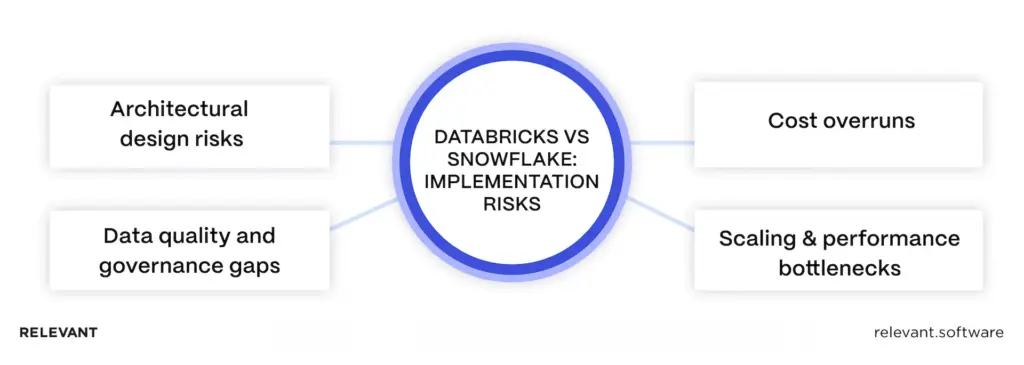
Architectural design risks
Architecture risk appears when teams copy a reference diagram and treat it as production. A safer approach defines workload isolation, data domain boundaries, and ownership rules before pipeline work begins.
Avoidable failure patterns:
- One shared compute pool for everything, which creates noisy-neighbor incidents
- No curated zone definition, which turns the platform into a dumping ground
- Missing lifecycle rules, so storage and tables grow without retention discipline.
Cost overruns
Cost overruns rarely come from a single expensive query. They come from uncontrolled compute replication, pipelines that rerun too often, and the lack of cost attribution by domain.
Controls that prevent runaway spend:
- Chargeback or showback by domain, environment, and workload class
- Hard limits for experimentation compute, with explicit exception processes.
- Monthly unit economics reviews are tied to business outcomes, not only platform metrics.
Data quality and governance gaps
Governance gaps show up as “two numbers for the same metric,” and they escalate into audit risk and executive distrust. Fixing governance late incurs higher costs because it forces rework across pipelines and dashboards.
Controls that keep trust stable:
- A data contract approach for key domains, with owners and schema expectations
- A documented metric layer so BI and product analytics stay aligned
- Role reviews and access audits on a schedule, not only after incidents
Scaling and performance bottlenecks
Scaling bottlenecks often appear when adoption crosses business units. Queries become concurrent, pipelines overlap, and SLAs break. At that stage, the platform needs workload design discipline, not only “more compute.”
Controls that keep performance predictable:
- Workload separation by environment and function (ingest, transform, BI, ML)
- Backfill strategies that avoid reprocessing the full history by default
- Clear operational SLAs, then platform policies aligned to those SLAs
How a data engineering partner helps de-risk platform adoption
A partner adds value when decisions are expensive to reverse. Platform adoption ties to cloud spend, staffing, and product roadmaps, so “trial and error” becomes a costly strategy. If stakeholders raise Snowflake vs. Databricks market share, treat it as a weak signal and focus on your rollout path, team skills, and workload ROI instead.
This section outlines the concrete work a senior delivery team should perform, especially when governance and ROI are at play.
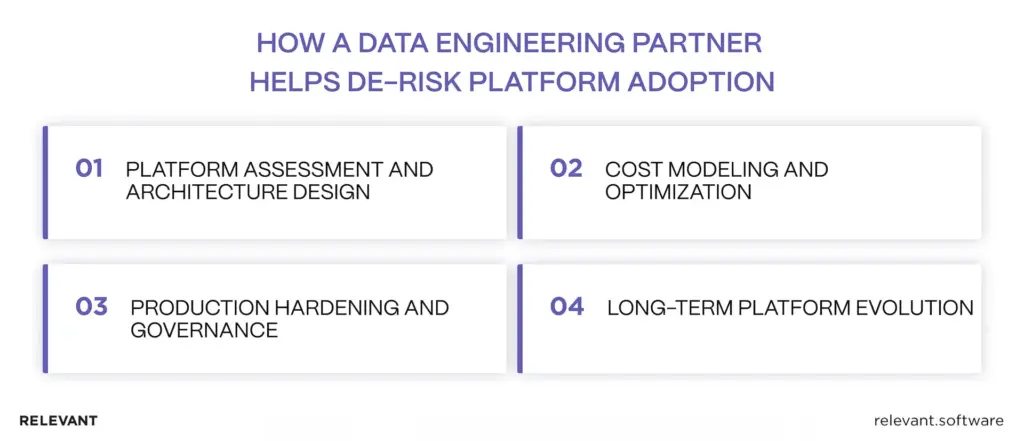
Platform assessment and architecture design
A strong assessment maps business use cases to workload profiles, then turns them into an architecture blueprint with clear ownership and integration patterns. This step prevents the common trap of building pipelines first and then arguing about governance later.
Relevant Software typically begins with data strategy and architecture work that aligns governance, integration, and workload isolation to enterprise constraints.
Cost modeling and optimization
Cost modeling should tie to workload units: dashboard refreshes, batch loads, streaming volume, and ML training cycles. A partner can build a forecast model, then validate it with a pilot that mirrors production constraints.
If your organization wants a broader cost-and-control framework across platforms, data analytics companies like Relevant Software help define governance and operating models that keep costs attributable and predictable.
Production hardening and governance
Production hardening covers reliability patterns: monitoring, incident response, access controls, and audit readiness. It also includes data quality enforcement so BI outputs remain stable as sources evolve.
Teams that plan to scale analytics across business units often combine this with data analytics services that deliver curated datasets, dashboards, and operational metrics tied to real decisions.
Long-term platform evolution
Platforms evolve as new use cases emerge: product analytics, embedded dashboards, generative AI features, and multi-region operations. A delivery partner should define an evolution plan to prevent “platform drift,” in which each team builds its own patterns and governance collapses.
If the roadmap includes high data volumes, event pipelines, or multi-domain integration, big data services can support scalable architectures that scale with growth.
Databricks vs Snowflake: final thoughts
If you are close to a platform decision, the best next move is to convert debate into a decision package that procurement, security, and engineering can all sign off on. That package should answer three questions with evidence: what you will run, how you will control it, and what it will cost as adoption grows.
Relevant Software can lead that work through a short, senior-led platform selection engagement that produces:
- Target architecture with workload lanes, integration points, and isolation rules
- Workload-based cost model with scaling scenarios and guardrails
- A governance plan that covers access, lineage, compliance, and operating ownership
If you want to move from “we think” to “we know,” start with our data strategy consulting. Contact us!